


Page 50 - Read Online
P. 50
Li et al. J Mater Inf 2024;4:4  I http://dx.doi.org/10.20517/jmi.2023.41          Page 5 of 14


                 A                                                      B


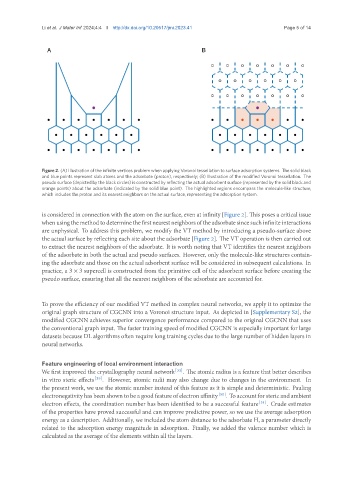
               Figure 2. (A) Illustration of the infinite vertices problem when applying Voronoi tessellation to surface adsorption systems. The solid black
               and blue points represent slab atoms and the adsorbate (proton), respectively; (B) Illustration of the modified Voronoi tessellation. The
               pseudo surface (depicted by the black circles) is constructed by reflecting the actual adsorbent surface (represented by the solid black and
               orange points) about the adsorbate (indicated by the solid blue point). The highlighted regions encompass the molecule-like structure,
               which includes the proton and its nearest neighbors on the actual surface, representing the adsorption system.


               is considered in connection with the atom on the surface, even at infinity [Figure 2]. This poses a critical issue
               whenusingthemethodtodeterminethefirstnearestneighborsoftheadsorbatesincesuchinfiniteinteractions
               are unphysical. To address this problem, we modify the VT method by introducing a pseudo-surface above
               the actual surface by reflecting each site about the adsorbate [Figure 2]. The VT operation is then carried out
               to extract the nearest neighbors of the adsorbate. It is worth noting that VT identifies the nearest neighbors
               of the adsorbate in both the actual and pseudo surfaces. However, only the molecule-like structures contain-
               ing the adsorbate and those on the actual adsorbent surface will be considered in subsequent calculations. In
               practice, a 3 × 3 supercell is constructed from the primitive cell of the adsorbent surface before creating the
               pseudo surface, ensuring that all the nearest neighbors of the adsorbate are accounted for.


               To prove the efficiency of our modified VT method in complex neural networks, we apply it to optimize the
               original graph structure of CGCNN into a Voronoi structure input. As depicted in [Supplementary S2], the
               modified CGCNN achieves superior convergence performance compared to the original CGCNN that uses
               the conventional graph input. The faster training speed of modified CGCNN is especially important for large
               datasets because DL algorithms often require long training cycles due to the large number of hidden layers in
               neural networks.


               Feature engineering of local environment interaction
               We first improved the crystallography neural network [33] . The atomic radius is a feature that better describes
               in vitro steric effects [35] . However, atomic radii may also change due to changes in the environment. In
               the present work, we use the atomic number instead of this feature as it is simple and deterministic. Pauling
               electronegativityhas been shown to be a good feature of electron affinity [50] . To account for steric andambient
               electron effects, the coordination number has been identified to be a successful feature [51] . Crude estimates
               of the properties have proved successful and can improve predictive power, so we use the average adsorption
               energy as a description. Additionally, we included the atom distance to the adsorbate H, a parameter directly
               related to the adsorption energy magnitude in adsorption. Finally, we added the valence number which is
               calculated as the average of the elements within all the layers.

