


Page 56 - Read Online
P. 56
Li et al. J Mater Inf 2024;4:4  I http://dx.doi.org/10.20517/jmi.2023.41         Page 11 of 14


                H adsorption
                                                                           MDAE(eV)        MAE(eV)


                            Error
                                                                           MARPD(%)        R²


                                                                              LERN   CGCNN   SchNet  MEGNET
                                                                                   DimeNet  ComENet  AliGNN
                   A                                                                          B                                                     C

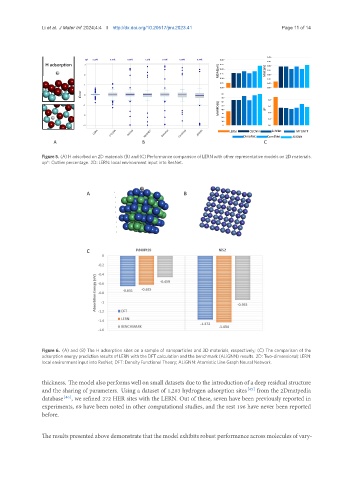
               Figure 5. (A) H adsorbed on 2D materials (B) and (C) Performance comparison of LERN with other representative models on 2D materials.
               op*: Outlier percentage. 2D: LERN: local environment input into ResNet.


                              A                                  B


                              C


               Figure 6. (A) and (B) The H adsorption sites on a sample of nanoparticles and 2D materials, respectively; (C) The comparison of the
               adsorption energy prediction results of LERN with the DFT calculation and the benchmark (ALiGNN) results. 2D: Two-dimensional; LERN:
               local environment input into ResNet; DFT: Density Functional Theory; ALiGNN: Atomistic Line Graph Neural Network.


               thickness. The model also performs well on small datasets due to the introduction of a deep residual structure
               and the sharing of parameters. Using a dataset of 1,283 hydrogen adsorption sites [45]  from the 2Dmatpedia
               database [46] , we refined 272 HER sites with the LERN. Out of these, seven have been previously reported in
               experiments, 69 have been noted in other computational studies, and the rest 196 have never been reported
               before.


               The results presented above demonstrate that the model exhibits robust performance across molecules of vary-

