


Page 25 - Read Online
P. 25
Page 8 of 14                           Pei et al. J Mater Inf 2023;3:26  https://dx.doi.org/10.20517/jmi.2023.35


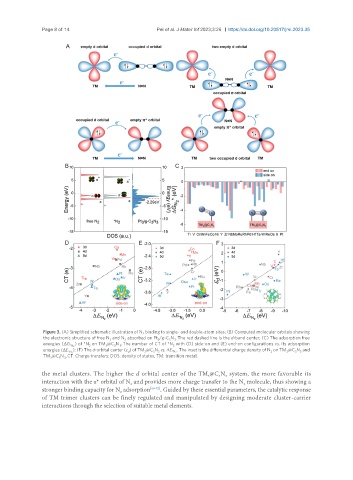
                Figure 3. (A) Simplified schematic illustration of N  binding to single- and double-atom sites; (B) Computed molecular orbitals showing
                                                 2
                the electronic structure of free N  and N  absorbed on Pt /g-C N . The red dashed line is the d-band center; (C) The adsorption free
                                      2    2          3   3  3
                energies (ΔG  ) of *N  on TM @C N . The number of CT of *N  with (D) side-on and (E) end-on configurations vs. its adsorption
                         *N 2  2     3  3  3               2
                                                             . The inset is the differential charge density of N  on TM @C N  and
                                            d
                                                  3
                                                      3
                                                     3
                energies (ΔE ); (F) The d-orbital center (ε ) of TM @C N  vs. ΔE *N 2       2     3  3  3
                        *N 2
                TM @C N . CT: Charge transfers; DOS: density of states; TM: transition metal.
                       3
                  3
                     3
               the metal clusters. The higher the d orbital center of the TM @C N  system, the more favorable its
                                                                             3
                                                                           3
                                                                       3
               interaction with the π* orbital of N  and provides more charge transfer to the N  molecule, thus showing a
                                             2
                                                                                   2
               stronger binding capacity for N  adsorption [69-72] . Guided by these essential parameters, the catalytic response
                                          2
               of TM trimer clusters can be finely regulated and manipulated by designing moderate cluster-carrier
               interactions through the selection of suitable metal elements.

