


Page 24 - Read Online
P. 24
Pei et al. J Mater Inf 2023;3:26  https://dx.doi.org/10.20517/jmi.2023.35        Page 7 of 14


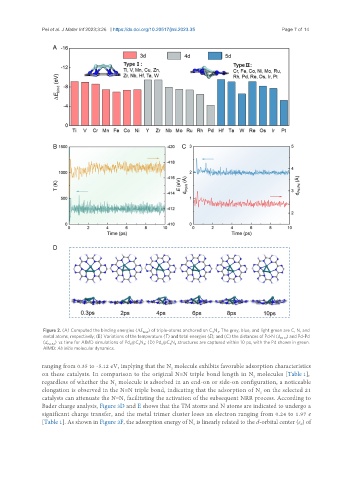
                Figure 2. (A) Computed the binding energies (ΔE  ) of triple-atoms anchored on C N . The grey, blue, and light green are C, N, and
                                                 bind                    3  3
                metal atoms, respectively; (B) Variations of the temperature (T) and total energies (E); and (C) the distances of Pd-N (d Pd-N ) and Pd-Pd
                (d Pd-Pd )  vs. time for AIMD simulations of Pd @C N ; (D) Pd @C N  structures are captured within 10 ps, with the Pd shown in green.
                                             3
                                                            3
                                                 3
                                                       3
                                                          3
                                                3
                AIMD: Ab initio molecular dynamics.
               ranging from 0.35 to -5.12 eV, implying that the N  molecule exhibits favorable adsorption characteristics
                                                           2
               on these catalysts. In comparison to the original N≡N triple bond length in N  molecules [Table 1],
                                                                                      2
               regardless of whether the N  molecule is adsorbed in an end-on or side-on configuration, a noticeable
                                        2
               elongation is observed in the N≡N triple bond, indicating that the adsorption of N  on the selected 21
                                                                                         2
               catalysts can attenuate the N≡N, facilitating the activation of the subsequent NRR process. According to
               Bader charge analysis, Figure 3D and E shows that the TM atoms and N atoms are indicated to undergo a
               significant charge transfer, and the metal trimer cluster loses an electron ranging from 0.24 to 1.97 e
               [Table 1]. As shown in Figure 3F, the adsorption energy of N  is linearly related to the d-orbital center (ε ) of
                                                                                                      d
                                                                  2

