


Page 21 - Read Online
P. 21
Page 4 of 14                           Pei et al. J Mater Inf 2023;3:26  https://dx.doi.org/10.20517/jmi.2023.35

                                           [57]
               the k-point using a 2 × 2 × 1 grid . Ab initio molecular dynamics (AIMD) simulations were performed at a
               temperature of 300 K in an NVT ensemble for a duration of 10 ps in order to estimate the thermodynamic
               stability of the TM @C N  systems.
                               3
                                  3
                                    3
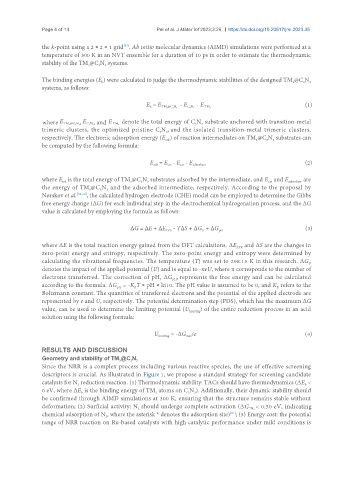
               The binding energies (E ) were calculated to judge the thermodynamic stabilities of the designed TM @C N 3
                                                                                                       3
                                   b
                                                                                                    3
               systems, as follows:
                                                  E  = E TM 3 @C 3 N 3   - E C 3 N 3  - E  TM 3         (1)
                                                    b

                                          denote the total energy of C N  substrate anchored with transition-metal
               where E TM 3 @C 3 N 3, E C 3 N 3, and  E TM 3       3  3
               trimeric clusters, the optimized pristine C N , and the isolated transition-metal trimeric clusters,
                                                         3
                                                       3
               respectively. The electronic adsorption energy (E ) of reaction intermediates on TM @C N  substrates can
                                                                                             3
                                                                                           3
                                                                                       3
                                                         ads
               be computed by the following formula:
                                                    E  = E  - E  - E adsorbate                                          (2)
                                                     ads
                                                          tot
                                                              cat
               where E  is the total energy of TM @C N  substrates adsorbed by the intermediate, and E  and E adsorbate  are
                                                                                           cat
                      tot
                                                   3
                                             3
                                                3
               the energy of TM @C N  and the adsorbed intermediate, respectively. According to the proposal by
                                     3
                                   3
                               3
               Nørskov et al. [58-60] , the calculated hydrogen electrode (CHE) model can be employed to determine the Gibbs
               free energy change (∆G) for each individual step in the electrochemical hydrogenation process, and the ∆G
               value is calculated by employing the formula as follows:
                                             ∆G = ∆E + ∆E  - T∆S + ∆G  + ∆G pH                               (3)
                                                         ZPE
                                                                     U
               where ∆E is the total reaction energy gained from the DFT calculations. ∆E  and ∆S are the changes in
                                                                                 ZPE
               zero-point energy and entropy, respectively. The zero-point energy and entropy were determined by
               calculating the vibrational frequencies. The temperature (T) was set to 298.15 K in this research. ∆G U
               denotes the impact of the applied potential (U) and is equal to -neU, where n corresponds to the number of
               electrons transferred. The correction of pH, ∆G , represents the free energy and can be calculated
                                                           pH
               according to the formula: ∆G  = -K T × pH × ln10. The pH value is assumed to be 0, and K  refers to the
                                        pH
                                                                                              B
                                              B
               Boltzmann constant. The quantities of transferred electrons and the potential of the applied electrode are
               represented by e and U, respectively. The potential determination step (PDS), which has the maximum ∆G
               value, can be used to determine the limiting potential (U limiting ) of the entire reduction process in an acid
               solution using the following formula:
                                                     U limiting  = -∆G /e                               (4)
                                                                max
               RESULTS AND DISCUSSION
               Geometry and stability of TM @C N
                                         3   3  3
               Since the NRR is a complex process including various reactive species, the use of effective screening
               descriptors is crucial. As illustrated in Figure 1, we propose a standard strategy for screening candidate
               catalysts for N  reduction reaction. (1) Thermodynamic stability: TACs should have thermodynamics (∆E  <
                                                                                                        b
                           2
               0 eV, where ∆E  is the binding energy of TM  atoms on C N ). Additionally, their dynamic stability should
                                                                3
                                                     3
                                                                  3
                            b
               be confirmed through AIMD simulations at 300 K, ensuring that the structure remains stable without
                                                                                        < 0.50 eV, indicating
                                               2
               deformation; (2) Surficial activity: N  should undergo complete activation (∆G *N 2
               chemical adsorption of N , where the asterisk * denotes the adsorption site) ; (3) Energy cost: the potential
                                                                               [61]
                                     2
               range of NRR reaction on Ru-based catalysts with high catalytic performance under mild conditions is

