


Page 27 - Read Online
P. 27
Page 10 of 14                          Pei et al. J Mater Inf 2023;3:26  https://dx.doi.org/10.20517/jmi.2023.35

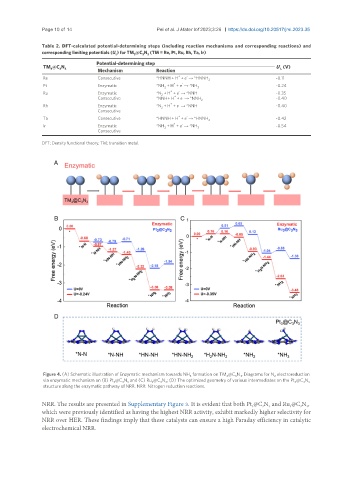
               Table  2.  DFT-calculated  potential-determining  steps  (including  reaction  mechanisms  and  corresponding  reactions)  and
               corresponding limiting potentials (U ) for TM @C N  (TM = Re, Pt, Ru, Rh, Ta, Ir)
                                              3
                                        L
                                                   3
                                                 3
                                  Potential-determining step
                TM @C N 3         Mechanism           Reaction                                U  (V)
                  3
                     3
                                                                                                L
                                                                -
                                                             +
                Re                Consecutive         *HNNH + H  + e  → *HNNH 2               -0.11
                                                            +  -
                Pt                Enzymatic           *NH  + H  + e  → *NH                    -0.24
                                                        2           3
                                                          +  -
                Ru                Enzymatic           *N  + H  + e  → *NNH                    -0.35
                                                       2    +  -
                                  Consecutive         *NNH+ H  + e  → *NNH 2                  -0.40
                                                          +  -
                Rh                Enzymatic           *N  + H  + e  → *NNH                    -0.40
                                                       2
                                  Consecutive
                                                             +
                                                                -
                Ta                Consecutive         *HNNH + H  + e  → *HNNH 2               -0.42
                                                            +  -
                Ir                Enzymatic           *NH  + H  + e  → *NH                    -0.54
                                                        2           3
                                  Consecutive
               DFT: Density functional theory; TM: transition metal.


                Figure 4. (A) Schematic illustration of Enzymatic mechanism towards NH  formation on TM @C N . Diagrams for N  electroreduction
                                                                 3           3  3  3         2
                via enzymatic mechanism on (B) Pt @C N  and (C) Ru @C N ; (D) The optimized geometry of various intermediates on the Pt @C N   3
                                                                                                    3
                                                                                                       3
                                            3
                                          3
                                       3
                                                         3
                                                       3
                                                    3
                structure along the enzymatic pathway of NRR. NRR: Nitrogen reduction reactions.
               NRR. The results are presented in Supplementary Figure 3. It is evident that both Pt @C N  and Ru @C N ,
                                                                                                   3
                                                                                                      3
                                                                                                        3
                                                                                         3
                                                                                            3
                                                                                      3
               which were previously identified as having the highest NRR activity, exhibit markedly higher selectivity for
               NRR over HER. These findings imply that these catalysts can ensure a high Faraday efficiency in catalytic
               electrochemical NRR.

