


Page 96 - Read Online
P. 96
Page 10 of 20           Andjelkovic et al. J Environ Expo Assess 2024;3:23  https://dx.doi.org/10.20517/jeea.2024.22

                                                   *
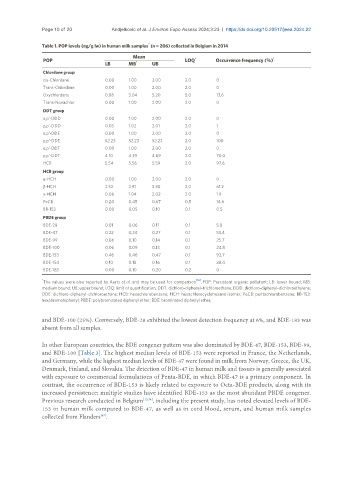
               Table 1. POP levels (ng/g lw) in human milk samples  (n = 206) collected in Belgium in 2014
                                              Mean
                POP                                            LOQ *      Occurrence frequency (%) *
                                    LB      MB *    UB
                Chlordane group
                cis-Chlordane       0.00    1.00    2.00       2.0        0
                Trans-Chlordane     0.00    1.00    2.00       2.0        0
                Oxychlordane        0.88    3.04    5.20       5.0        13.6
                Trans-Nonachlor     0.00    1.00    2.00       2.0        0
                DDT group
                o,p’-DDD            0.00    1.00    2.00       2.0        0
                p,p’-DDD            0.03    1.02    2.01       2.0        1
                o,p’-DDE            0.00    1.00    2.00       2.0        0
                p,p’-DDE            52.23   52.23   52.23      2.0        100
                o,p’-DDT            0.00    1.00    2.00       2.0        0
                p,p’-DDT            4.10    4.39    4.69       2.0        70.0
                HCB                 5.54    5.56    5.59       2.0        97.6
                HCB group
                α-HCH               0.00    1.00    2.00       2.0        0
                β-HCH               2.52    2.91    3.30       2.0        61.2
                γ-HCH               0.06    1.04    2.02       2.0        1.9
                PeCB                0.24    0.45    0.67       0.5        14.6
                BB-153              0.00    0.05    0.10       0.1        0.5
                PBDE group
                BDE-28              0.01    0.06    0.11       0.1        5.8
                BDE-47              0.22    0.24    0.27       0.1        53.4
                BDE-99              0.06    0.10    0.14       0.1        25.7
                BDE-100             0.06    0.09    0.13       0.1        24.8
                BDE-153             0.46    0.46    0.47       0.1        92.7
                BDE-154             0.10    0.13    0.16       0.1        38.4
                BDE-183             0.00    0.10    0.20       0.2        0

               *                                                   [16]
                The values were also reported by Aerts et al. and may be used for  comparison  . POP: Persistent organic pollutant; LB: lower bound; MB:
               medium bound; UB: upper bound; LOQ: limit of quantification; DDT: dichloro-diphenyl-trichloroethane; DDD: dichloro-diphenyl-dichloroethylene;
               DDE: dichloro-diphenyl-dichloroethane; HCB: hexachlorobenzene; HCH: hexachlorocyclohexane isomer; PeCB: pentachlorobenzene; BB-153:
               hexabromobiphenyl; PBDE: polybrominated diphenyl ether; BDE: brominated diphenyl ether.

               and BDE-100 (25%). Conversely, BDE-28 exhibited the lowest detection frequency at 6%, and BDE-183 was
               absent from all samples.


               In other European countries, the BDE congener pattern was also dominated by BDE-47, BDE-153, BDE-99,
               and BDE-100 [Table 3]. The highest median levels of BDE-153 were reported in France, the Netherlands,
               and Germany, while the highest median levels of BDE-47 were found in milk from Norway, Greece, the UK,
               Denmark, Finland, and Slovakia. The detection of BDE-47 in human milk and tissues is generally associated
               with exposure to commercial formulations of Penta-BDE, in which BDE-47 is a primary component. In
               contrast, the occurrence of BDE-153 is likely related to exposure to Octa-BDE products, along with its
               increased persistence; multiple studies have identified BDE-153 as the most abundant PBDE congener.
               Previous research conducted in Belgium [15,34] , including the present study, has noted elevated levels of BDE-
               153 in human milk compared to BDE-47, as well as in cord blood, serum, and human milk samples
               collected from Flanders .
                                   [47]

