


Page 93 - Read Online
P. 93
Andjelkovic et al. J Environ Expo Assess 2024;3:23  https://dx.doi.org/10.20517/jeea.2024.22  Page 7 of 20

               of zero and ½ LOQ, respectively, to samples where the pollutant concentration was not detected. For the
               upper bound, the levels of LOQ were assigned.

               Exposure assessment and risk characterization
               Exposure assessment
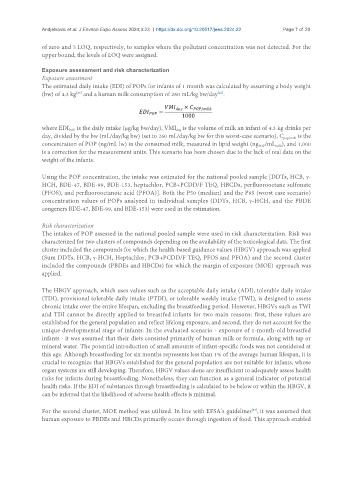
               The estimated daily intake (EDI) of POPs for infants of 1 month was calculated by assuming a body weight
                                                                          [26]
                           [25]
               (bw) of 4.3 kg  and a human milk consumption of 260 mL/kg bw/day .


               where EDI  is the daily intake (µg/kg bw/day), VMI  is the volume of milk an infant of 4.3 kg drinks per
                        POP
                                                            day
               day, divided by the bw (mL/day/kg bw) (set to 260 mL/day/kg bw for this worst-case scenario), C pop/milk  is the
               concentration of POP (ng/mL lw) in the consumed milk, measured in lipid weight (ng /mL ), and 1,000
                                                                                        POP
                                                                                              milk
               is a correction for the measurement units. This scenario has been chosen due to the lack of real data on the
               weight of the infants.
               Using the POP concentration, the intake was estimated for the national pooled sample [DDTs, HCB, γ-
               HCH, BDE-47, BDE-99, BDE-153, heptachlor, PCB+PCDD/F TEQ, HBCDs, perfluorooctane sulfonate
               (PFOS), and perfluorooctanoic acid (PFOA)]. Both the P50 (median) and the P95 (worst case scenario)
               concentration values of POPs analyzed in individual samples (DDTs, HCB, γ-HCH, and the PBDE
               congeners BDE-47, BDE-99, and BDE-153) were used in the estimation.


               Risk characterization
               The intakes of POP assessed in the national pooled sample were used in risk characterization. Risk was
               characterized for two clusters of compounds depending on the availability of the toxicological data. The first
               cluster included the compounds for which the health-based guidance values (HBGV) approach was applied
               (Sum DDTs, HCB, γ-HCH, Heptachlor, PCB+PCDD/F TEQ, PFOS and PFOA) and the second cluster
               included the compounds (PBDEs and HBCDs) for which the margin of exposure (MOE) approach was
               applied.

               The HBGV approach, which uses values such as the acceptable daily intake (ADI), tolerable daily intake
               (TDI), provisional tolerable daily intake (PTDI), or tolerable weekly intake (TWI), is designed to assess
               chronic intake over the entire lifespan, excluding the breastfeeding period. However, HBGVs such as TWI
               and TDI cannot be directly applied to breastfed infants for two main reasons: first, these values are
               established for the general population and reflect lifelong exposure, and second, they do not account for the
               unique developmental stage of infants. In the evaluated scenario - exposure of 1-month-old breastfed
               infants - it was assumed that their diets consisted primarily of human milk or formula, along with tap or
               mineral water. The potential introduction of small amounts of infant-specific foods was not considered at
               this age. Although breastfeeding for six months represents less than 1% of the average human lifespan, it is
               crucial to recognize that HBGVs established for the general population are not suitable for infants, whose
               organ systems are still developing. Therefore, HBGV values alone are insufficient to adequately assess health
               risks for infants during breastfeeding. Nonetheless, they can function as a general indicator of potential
               health risks. If the EDI of substances through breastfeeding is calculated to be below or within the HBGV, it
               can be inferred that the likelihood of adverse health effects is minimal.


               For the second cluster, MOE method was utilized. In line with EFSA’s guidelines , it was assumed that
                                                                                      [27]
               human exposure to PBDEs and HBCDs primarily occurs through ingestion of food. This approach enabled

