


Page 94 - Read Online
P. 94
Page 8 of 20            Andjelkovic et al. J Environ Expo Assess 2024;3:23  https://dx.doi.org/10.20517/jeea.2024.22

               the estimation of chronic dietary intake (D ), which reflects the body burden in an average individual.
                                                     r,h
               Another assumption made is that PBDEs and HBCDs predominantly accumulate in adipose tissue,
               suggesting that a one-compartment model is adequate for kinetic analysis. As a result, determining chronic
               dietary intake in humans (D ) necessitates accounting for the steady-state body burden at the BMDL10, the
                                       r,h
               proportion of daily intake that is absorbed by the body, and the rate constant governing the elimination of
               the compound.

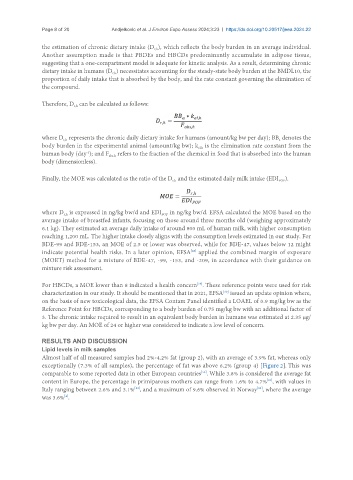
               Therefore, D  can be calculated as follows:
                          r,h


               where D  represents the chronic daily dietary intake for humans (amount/kg bw per day); BB  denotes the
                      r,h
                                                                                               a
               body burden in the experimental animal (amount/kg bw); k  is the elimination rate constant from the
                                                                    el,h
               human body (day ); and F  refers to the fraction of the chemical in food that is absorbed into the human
                              -1
                                      abs,h
               body (dimensionless).
               Finally, the MOE was calculated as the ratio of the D  and the estimated daily milk intake (EDI ).
                                                           r,h
                                                                                               POP


               where D  is expressed in ng/kg bw/d and EDI  in ng/kg bw/d. EFSA calculated the MOE based on the
                       r,h
                                                       POP
               average intake of breastfed infants, focusing on those around three months old (weighing approximately
               6.1 kg). They estimated an average daily intake of around 800 mL of human milk, with higher consumption
               reaching 1,200 mL. The higher intake closely aligns with the consumption levels estimated in our study. For
               BDE-99 and BDE-153, an MOE of 2.5 or lower was observed, while for BDE-47, values below 12 might
                                                                 [28]
               indicate potential health risks. In a later opinion, EFSA  applied the combined margin of exposure
               (MOET) method for a mixture of BDE-47, -99, -153, and -209, in accordance with their guidance on
               mixture risk assessment.

               For HBCDs, a MOE lower than 8 indicated a health concern . These reference points were used for risk
                                                                   [29]
               characterization in our study. It should be mentioned that in 2021, EFSA  issued an update opinion where,
                                                                            [30]
               on the basis of new toxicological data, the EFSA Contam Panel identified a LOAEL of 0.9 mg/kg bw as the
               Reference Point for HBCDs, corresponding to a body burden of 0.75 mg/kg bw with an additional factor of
               3. The chronic intake required to result in an equivalent body burden in humans was estimated at 2.35 µg/
               kg bw per day. An MOE of 24 or higher was considered to indicate a low level of concern.

               RESULTS AND DISCUSSION
               Lipid levels in milk samples
               Almost half of all measured samples had 2%-4.2% fat (group 2), with an average of 3.9% fat, whereas only
               exceptionally (7.3% of all samples), the percentage of fat was above 6.2% (group 4) [Figure 2]. This was
                                                                     [16]
               comparable to some reported data in other European countries . While 3.8% is considered the average fat
               content in Europe, the percentage in primiparous mothers can range from 1.6% to 4.7% , with values in
                                                                                           [31]
                                                                                        [33]
               Italy ranging between 2.6% and 3.1% , and a maximum of 9.6% observed in Norway , where the average
                                              [32]
               was 3.6% .
                       [4]

