


Page 63 - Read Online
P. 63
Page 12 of 17               Rawn et al. J Environ Expo Assess 2024;3:16  https://dx.doi.org/10.20517/jeea.2024.04

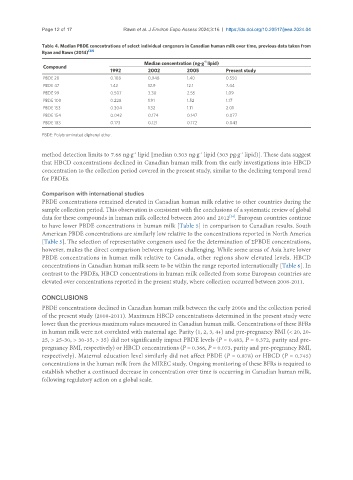
               Table 4. Median PBDE concentrations of select individual congeners in Canadian human milk over time, previous data taken from
               Ryan and Rawn (2014) [28]

                                                                      -1
                                                  Median concentration (ng·g  lipid)
                Compound
                                      1992         2002         2005         Present study
                PBDE 28               0.108        0.948        1.40         0.550
                PBDE 47               1.42         12.9         12.1         7.44
                PBDE 99               0.507        3.30         2.55         1.09
                PBDE 100              0.228        1.91         1.52         1.17
                PBDE 153              0.304        1.32         1.11         2.01
                PBDE 154              0.042        0.174        0.147        0.077
                PBDE 183              0.173        0.121        0.172        0.043
               PBDE: Polybrominated diphenyl ether.


                                                                    -1
                                                                                  -1
                                              -1
               method detection limits to 7.66 ng·g  lipid [median 0.303 ng·g  lipid (303 pg·g  lipid)]. These data suggest
               that HBCD concentrations declined in Canadian human milk from the early investigations into HBCD
               concentration to the collection period covered in the present study, similar to the declining temporal trend
               for PBDEs.
               Comparison with international studies
               PBDE concentrations remained elevated in Canadian human milk relative to other countries during the
               sample collection period. This observation is consistent with the conclusions of a systematic review of global
               data for these compounds in human milk collected between 2000 and 2012 . European countries continue
                                                                              [54]
               to have lower PBDE concentrations in human milk [Table 5] in comparison to Canadian results. South
               American PBDE concentrations are similarly low relative to the concentrations reported in North America
               [Table 5]. The selection of representative congeners used for the determination of ΣPBDE concentrations,
               however, makes the direct comparison between regions challenging. While some areas of Asia have lower
               PBDE concentrations in human milk relative to Canada, other regions show elevated levels. HBCD
               concentrations in Canadian human milk seem to be within the range reported internationally [Table 6]. In
               contrast to the PBDEs, HBCD concentrations in human milk collected from some European countries are
               elevated over concentrations reported in the present study, where collection occurred between 2008-2011.


               CONCLUSIONS
               PBDE concentrations declined in Canadian human milk between the early 2000s and the collection period
               of the present study (2008-2011). Maximum HBCD concentrations determined in the present study were
               lower than the previous maximum values measured in Canadian human milk. Concentrations of these BFRs
               in human milk were not correlated with maternal age. Parity (1, 2, 3, 4+) and pre-pregnancy BMI (< 20, 20-
               25, > 25-30, > 30-35, > 35) did not significantly impact PBDE levels (P = 0.483, P = 0.372, parity and pre-
               pregnancy BMI, respectively) or HBCD concentrations (P = 0.366, P = 0.073, parity and pre-pregnancy BMI,
               respectively). Maternal education level similarly did not affect PBDE (P = 0.878) or HBCD (P = 0.745)
               concentrations in the human milk from the MIREC study. Ongoing monitoring of these BFRs is required to
               establish whether a continued decrease in concentration over time is occurring in Canadian human milk,
               following regulatory action on a global scale.

