


Page 61 - Read Online
P. 61
Page 10 of 17               Rawn et al. J Environ Expo Assess 2024;3:16  https://dx.doi.org/10.20517/jeea.2024.04

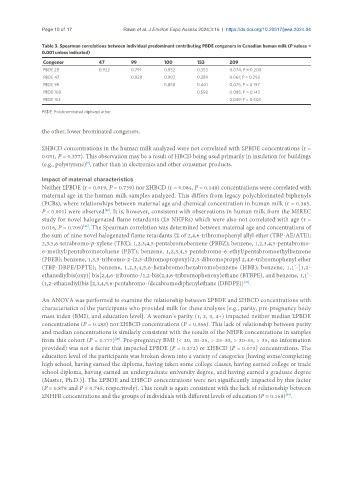
               Table 3. Spearman correlations between individual predominant contributing PBDE congeners in Canadian human milk (P values <
               0.001 unless indicated)
                Congener          47         99         100        153        209
                PBDE 28           0.922      0.791      0.832      0.353      0.074; P = 0.200
                PBDE 47                      0.920      0.907      0.389      0.061; P = 0.292
                PBDE 99                                 0.858      0.401      0.075; P = 0.197
                PBDE 100                                           0.592      0.085; P = 0.142
                PBDE 153                                                      0.039; P = 0.503
               PBDE: Polybrominated diphenyl ether.


               the other, lower brominated congeners.

               ΣHBCD concentrations in the human milk analyzed were not correlated with ΣPBDE concentrations (r =
               0.051, P = 0.377). This observation may be a result of HBCD being used primarily in insulation for buildings
               (e.g., polystyrene) , rather than in electronics and other consumer products.
                              [5]
               Impact of maternal characteristics
               Neither ΣPBDE (r = 0.019, P = 0.739) nor ΣHBCD (r = 0.084, P = 0.148) concentrations were correlated with
               maternal age in the human milk samples analyzed. This differs from legacy polychlorinated biphenyls
               (PCBs), where relationships between maternal age and chemical concentration in human milk (r = 0.385,
               P < 0.001) were observed . It is, however, consistent with observations in human milk from the MIREC
                                    [48]
               study for novel halogenated flame retardants (Σ9 NHFRs) which were also not correlated with age (r =
               0.016, P = 0.709) . The Spearman correlation was determined between maternal age and concentrations of
                             [49]
               the sum of nine novel halogenated flame retardants {Σ of 2,4,6-tribromophenyl allyl ether (TBP-AE/ATE);
               2,3,5,6-tetrabromo-p-xylene (TBX); 1,2,3,4,5-pentabromobenzene (PBBZ); benzene, 1,2,3,4,5-pentabromo-
               6-methyl/pentabromotoluene (PBT); benzene, 1,2,3,4,5 pentabromo-6-ethyl/pentabromoethylbenzene
               (PBEB); benzene, 1,3,5-tribromo-2-(2,3-dibromopropoxy)/2,3-dibromopropyl 2,4,6-tribromophenyl ether
               (TBP-DBPE/DPTE); benzene, 1,2,3,4,5,6-hexabromo/hexabromobenzene (HBB); benzene, 1,1’-[1,2-
               ethanediylbis(oxy)] bis[2,4,6-tribromo-/1,2-bis(2,4,6-tribromophenoxy)ethane (BTBPE), and benzene, 1,1’-
               (1,2-ethanediyl)bis [2,3,4,5,6-pentabromo-/decabromodiphenylethane (DBDPE)} .
                                                                                   [49]
               An ANOVA was performed to examine the relationship between ΣPBDE and ΣHBCD concentrations with
               characteristics of the participants who provided milk for these analyses [e.g., parity, pre-pregnancy body
               mass index (BMI), and education level]. A woman’s parity (1, 2, 3, 4+) impacted neither median ΣPBDE
               concentrations (P = 0.483) nor ΣHBCD concentrations (P = 0.366). This lack of relationship between parity
               and median concentrations is similarly consistent with the results of the NHFR concentrations in samples
               from this cohort (P = 0.777) . Pre-pregnancy BMI (< 20, 20-25, > 25-30, > 30-35, > 35, no information
                                        [49]
               provided) was not a factor that impacted ΣPBDE (P = 0.372) or ΣHBCD (P = 0.073) concentrations. The
               education level of the participants was broken down into a variety of categories [having some/completing
               high school, having earned the diploma, having taken some college classes, having earned college or trade
               school diploma, having earned an undergraduate university degree, and having earned a graduate degree
               (Master, Ph.D.)]. The ΣPBDE and ΣHBCD concentrations were not significantly impacted by this factor
               (P = 0.878 and P = 0.745, respectively). This result is again consistent with the lack of relationship between
                                                                                                 [49]
               ΣNHFR concentrations and the groups of individuals with different levels of education (P = 0.168) .

