


Page 59 - Read Online
P. 59
Page 8 of 17                Rawn et al. J Environ Expo Assess 2024;3:16  https://dx.doi.org/10.20517/jeea.2024.04


                                                                         -1
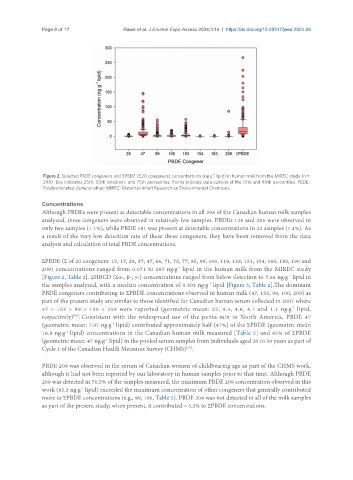
                Figure 2. Selected PBDE congeners and ΣPBDE (Σ20 congeners) concentrations (ng·g  lipid) in human milk from the MIREC study (n =
                298). Box indicates 25th, 50th (median), and 75th percentiles. Points indicate data outside of the 10th and 90th percentiles. PBDE:
                Polybrominated diphenyl ether; MIREC: Maternal-Infant Research on Environmental Chemicals.

               Concentrations
               Although PBDEs were present at detectable concentrations in all 298 of the Canadian human milk samples
               analyzed, three congeners were observed in relatively few samples. PBDEs 126 and 205 were observed in
               only two samples (< 1%), while PBDE 181 was present at detectable concentrations in 22 samples (7.4%). As
               a result of the very low detection rate of these three congeners, they have been removed from the data
               analysis and calculation of total PBDE concentrations.


               ΣPBDE (Σ of 20 congeners: 15, 17, 28, 37, 47, 66, 71, 75, 77, 85, 99, 100, 119, 138, 153, 154, 160, 183, 190 and
               209) concentrations ranged from 0.071 to 267 ng·g  lipid in the human milk from the MIREC study
                                                             -1
               [Figure 2, Table 2]. ΣHBCD (Σα-, β-, γ-) concentrations ranged from below detection to 7.66 ng·g  lipid in
                                                                                                  -1
               the samples analyzed, with a median concentration of 0.303 ng·g  lipid [Figure 3, Table 2].The dominant
                                                                       -1
               PBDE congeners contributing to ΣPBDE concentrations observed in human milk (47, 153, 99, 100, 209) as
               part of the present study are similar to those identified for Canadian human serum collected in 2007 where
               47 > 153 > 99 > 100 > 209 were reported (geometric mean: 22, 9.4, 4.6, 4.1 and 1.1  ng·g  lipid,
                                                                                                   -1
                          [30]
               respectively) . Consistent with the widespread use of the penta-mix in North America, PBDE 47
               (geometric mean: 7.97 ng·g  lipid) contributed approximately half (47%) of the ΣPBDE (geometric mean
                                       -1
                       -1
               16.8 ng·g  lipid) concentrations in the Canadian human milk measured [Table 2] and 45% of ΣPBDE
               (geometric mean: 47 ng·g  lipid) in the pooled serum samples from individuals aged 20 to 39 years as part of
                                    -1
                                                                [30]
               Cycle 1 of the Canadian Health Measures Survey (CHMS) .
               PBDE 209 was observed in the serum of Canadian women of childbearing age as part of the CHMS work,
               although it had not been reported by our laboratory in human samples prior to that time. Although PBDE
               209 was detected in 70.5% of the samples measured, the maximum PBDE 209 concentration observed in this
               work (85.3 ng·g  lipid) exceeded the maximum concentration of other congeners that generally contributed
                            -1
               more to ΣPBDE concentrations (e.g., 99, 100, Table 2). PBDE 209 was not detected in all of the milk samples
               as part of the present study; when present, it contributed ≈ 3.3% to ΣPBDE concentrations.

