


Page 45 - Read Online
P. 45
Bogdan et al. J Environ Expo Assess 2024;3:14  https://dx.doi.org/10.20517/jeea.2024.08  Page 7 of 13

                Volume of   Central tendency = 0.56 (calculated from human CR of 0.39 mL/kg/day [26] ) and the half-life
                distribution   CR ÷ [ln(2)/half-life] = V
                                          d
                (L/kg)    0.39 mL/kg/day ÷ [ln(2)/996 days] = 560 mL/kg, rounded to 0.56 L/kg
               PFOS: Perfluorooctanesulfonic acid; NHANES: National Health and Nutrition Examination Survey; t : half-life; TK: toxicokinetic; CR: clearance rate;
                                                                            ½
               V : volume of distribution.
                d
               Table 3. PFOS detection in one dairy-based infant formula powder
               PFOS in 20% w/v    PFOS in formula   Formula per   PFOS per   Water per   PFOS in reconstituted
               solution (SD) (ng/L)  powder (SD) (ng/g)  scoop (g)  scoop (ng)  scoop (L)  formula (ng/L)
                12 (0.6)          0.054 (0.003)     9.8          0.53      0.059      8.9
               n = 3. PFOS: perfluorooctanesulfonic acid; SD: standard deviation.


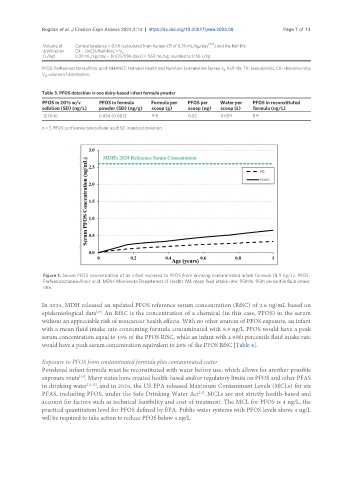
                Figure 1. Serum PFOS concentration of an infant exposed to PFOS from drinking contaminated infant formula (8.9 ng/L). PFOS:
                Perfluorooctanesulfonic acid; MDH: Minnesota Department of Health; MI: mean fluid intake rate; 95th%: 95th percentile fluid intake
                rate.

               In 2024, MDH released an updated PFOS reference serum concentration (RfSC) of 2.6 ng/mL based on
               epidemiological data . An RfSC is the concentration of a chemical (in this case, PFOS) in the serum
                                 [19]
               without an appreciable risk of noncancer health effects. With no other sources of PFOS exposure, an infant
               with a mean fluid intake rate consuming formula contaminated with 8.9 ng/L PFOS would have a peak
               serum concentration equal to 13% of the PFOS RfSC, while an infant with a 95th percentile fluid intake rate
               would have a peak serum concentration equivalent to 24% of the PFOS RfSC [Table 4].

               Exposure to PFOS from contaminated formula plus contaminated water
               Powdered infant formula must be reconstituted with water before use, which allows for another possible
                            [30]
               exposure route . Many states have created health-based and/or regulatory limits on PFOS and other PFAS
               in drinking water [31,32] , and in 2024, the US EPA released Maximum Contaminant Levels (MCLs) for six
               PFAS, including PFOS, under the Safe Drinking Water Act . MCLs are not strictly health-based and
                                                                    [33]
               account for factors such as technical feasibility and cost of treatment. The MCL for PFOS is 4 ng/L, the
               practical quantitation level for PFOS defined by EPA. Public water systems with PFOS levels above 4 ng/L
               will be required to take action to reduce PFOS below 4 ng/L.

