


Page 43 - Read Online
P. 43
Bogdan et al. J Environ Expo Assess 2024;3:14  https://dx.doi.org/10.20517/jeea.2024.08  Page 5 of 13

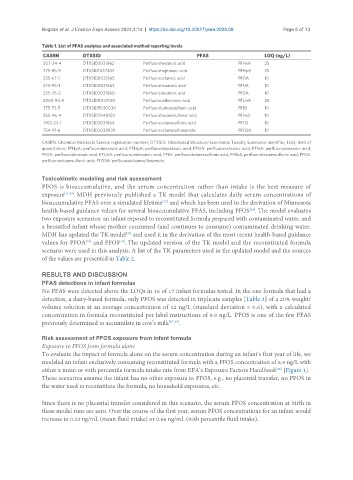
               Table 1. List of PFAS analytes and associated method reporting levels
                CASRN        DTXSID                                PFAS                   LOQ (ng/L)
                307-24-4     DTXSID3031862       Perfluorohexanoic acid          PFHxA    25
                375-85-9     DTXSID1037303       Perfluoroheptanoic acid         PFHpA    25
                335-67-1     DTXSID8031865       Perfluorooctanoic acid          PFOA     10
                375-95-1     DTXSID8031863       Perfluorononanoic acid          PFNA     10
                335-76-2     DTXSID3031860       Perfluorodecanoic acid          PFDA     10
                2058-94-8    DTXSID8047553       Perfluoroundecanoic acid        PFUnA    25
                375-73-5     DTXSID5030030       Perfluorobutanesulfonic acid    PFBS     10
                355-46-4     DTXSID7040150       Perfluorohexanesulfonic acid    PFHxS    10
                1763-23-1    DTXSID3031864       Perfluorooctanesulfonic acid    PFOS     10
                754-91-6     DTXSID3038939       Perfluorooctanesulfonamide      PFOSA    10

               CASRN: Chemical Abstracts Service registration number; DTXSID: Distributed Structure-Searchable Toxicity Substance Identifier; LOQ: limit of
               quantitation; PFHxA: perfluorohexanoic acid; PFHpA: perfluoroheptanoic acid; PFOA: perfluorooctanoic acid; PFNA: perfluorononanoic acid;
               PFDA: perfluorodecanoic acid; PFUnA: perfluoroundecanoic acid; PFBS: perfluorobutanesulfonic acid; PFHxS: perfluorohexanesulfonic acid; PFOS:
               perfluorooctanesulfonic acid; PFOSA: perfluorooctanesulfonamide.


               Toxicokinetic modeling and risk assessment
               PFOS is bioaccumulative, and the serum concentration rather than intake is the best measure of
               exposure [15,19] . MDH previously published a TK model that calculates daily serum concentrations of
                                                        [15]
               bioaccumulative PFAS over a simulated lifetime  and which has been used in the derivation of Minnesota
                                                                                     [14]
               health-based guidance values for several bioaccumulative PFAS, including PFOS . The model evaluates
               two exposure scenarios: an infant exposed to reconstituted formula prepared with contaminated water, and
               a breastfed infant whose mother consumed (and continues to consume) contaminated drinking water.
               MDH has updated the TK model  and used it in the derivation of the most recent health-based guidance
                                           [20]
                              [18]
               values for PFOA  and PFOS . The updated version of the TK model and the reconstituted formula
                                         [19]
               scenario were used in this analysis. A list of the TK parameters used in the updated model and the sources
               of the values are presented in Table 2.

               RESULTS AND DISCUSSION
               PFAS detections in infant formulas
               No PFAS were detected above the LOQs in 16 of 17 infant formulas tested. In the one formula that had a
               detection, a dairy-based formula, only PFOS was detected in triplicate samples [Table 3] of a 20% weight/
               volume solution at an average concentration of 12 ng/L (standard deviation = 0.6), with a calculated
               concentration in formula reconstituted per label instructions of 8.9 ng/L. PFOS is one of the few PFAS
               previously determined to accumulate in cow’s milk [27-29] .


               Risk assessment of PFOS exposure from infant formula
               Exposure to PFOS from formula alone
               To evaluate the impact of formula alone on the serum concentration during an infant’s first year of life, we
               modeled an infant exclusively consuming reconstituted formula with a PFOS concentration of 8.9 ng/L with
               either a mean or 95th percentile formula intake rate from EPA’s Exposure Factors Handbook  [Figure 1].
                                                                                              [25]
               These scenarios assume the infant has no other exposure to PFOS, e.g., no placental transfer, no PFOS in
               the water used to reconstitute the formula, no household exposures, etc.


               Since there is no placental transfer considered in this scenario, the serum PFOS concentration at birth in
               these model runs are zero. Over the course of the first year, serum PFOS concentrations for an infant would
               increase to 0.33 ng/mL (mean fluid intake) or 0.66 ng/mL (95th percentile fluid intake).

