


Page 44 - Read Online
P. 44
Page 6 of 13              Bogdan et al. J Environ Expo Assess 2024;3:14  https://dx.doi.org/10.20517/jeea.2024.08

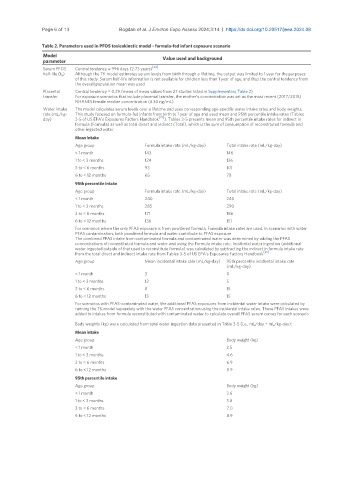
               Table 2. Parameters used in PFOS toxicokinetic model - formula-fed infant exposure scenario
                Model                                   Value used and background
                parameter
                                                    [24]
                Serum PFOS   Central tendency = 996 days (2.73 years)
                half-life (t )  Although the TK model estimates serum levels from birth through a lifetime, the output was limited to 1 year for the purposes
                      ½
                          of this study. Serum half-life information is not available for children less than 1 year of age, and thus the central tendency from
                          the overall population mean was used
                Placental   Central tendency = 0.39 (mean of mean values from 27 studies listed in Supplementary Table 2)
                transfer  For exposure scenarios that include placental transfer, the mother’s concentration was set as the most recent (2017/2018)
                          NHANES female median concentration (3.30 ng/mL)
                Water intake   The model calculates serum levels over a lifetime and uses corresponding age-specific water intake rates and body weights.
                rate (mL/kg-  This study focused on formula-fed infants from birth to 1 year of age and used mean and 95th percentile intake rates (Tables
                                                       [25]
                day)      3-5 of US EPA’s Exposures Factors Handbook  ). Tables 3-5 presents mean and 95th percentile intake rates for indirect in
                          formula (Formula) as well as total direct and indirect (Total), which is the sum of consumption of reconstituted formula and
                          other ingested water
                          Mean intake
                          Age group               Formula intake rate (mL/kg-day)  Total intake rate (mL/kg-day)
                          < 1 month               143                        146
                          1 to < 3 months         124                        136
                          3 to < 6 months         93                         101
                          6 to < 12 months        65                         78
                          95th percentile intake
                          Age group               Formula intake rate (mL/kg-day)  Total intake rate (mL/kg-day)
                          < 1 month               240                        240
                          1 to < 3 months         285                        290
                          3 to < 6 months         171                        186
                          6 to < 12 months        136                        151
                          For scenarios where the only PFAS exposure is from powdered formula, Formula intake rates are used. In scenarios with water
                          PFAS contamination, both powdered formula and water contribute to PFAS exposure
                          The combined PFAS intake from contaminated formula and contaminated water was determined by adding the PFAS
                          concentrations of reconstituted formula and water and using the Formula intake rate. Incidental water ingestion (additional
                          water ingested outside of that used to reconstitute formula) was calculated by subtracting the indirect in formula intake rate
                          from the total direct and indirect intake rate from Tables 3-5 of US EPA’s Exposures Factors Handbook [25]
                          Age group               Mean incidental intake rate (mL/kg-day)  95th percentile incidental intake rate
                                                                             (mL/kg-day)
                          < 1 month               3                          0
                          1 to < 3 months         12                         5
                          3 to < 6 months         8                          15
                          6 to < 12 months        13                         15
                          For scenarios with PFAS-contaminated water, the additional PFAS exposures from incidental water intake were calculated by
                          running the TK model separately with the water PFAS concentration using the incidental intake rates. Those PFAS intakes were
                          added to intakes from formula reconstituted with contaminated water to calculate overall PFAS serum curves for each scenario
                          Body weights (kg) were calculated from total water ingestion data presented in Table 3-5 (i.e., mL/day ÷ mL/kg-day):
                          Mean intake
                          Age group                                          Body weight (kg)
                          < 1 month                                          3.5
                          1 to < 3 months                                    4.6
                          3 to < 6 months                                    6.9
                          6 to < 12 months                                   8.9
                          95th percentile intake
                          Age group                                          Body weight (kg)
                          < 1 month                                          3.6
                          1 to < 3 months                                    3.8
                          3 to < 6 months                                    7.0
                          6 to < 12 months                                   8.9

