


Page 17 - Read Online
P. 17
Hammel et al. J Environ Expo Assess 2024;3:8  https://dx.doi.org/10.20517/jeea.2023.51   Page 11 of 17

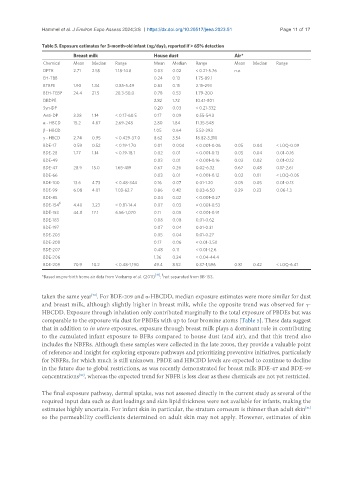
               Table 5. Exposure estimates for 3-month-old infant (ng/day), reported if > 65% detection
                          Breast milk                House dust                 Air*
                Chemical   Mean  Median  Range       Mean  Median  Range        Mean  Median  Range
                DPTE      2.71  2.55    1.18-14.8    0.03  0.02    < 0.21-5.76  n.a.
                EH-TBB                               0.24  0.13    1.75-89.1
                BTBPE     1.90  1.34    0.85-5.49    0.63  0.15    2.15-293
                BEH-TEBP  24.4  21.5    20.3-50.0    0.78  0.53    1.79-200
                DBDPE                                2.82  1.72    10.41-801
                Syn-DP                               0.20  0.03    < 0.21-332
                Anti-DP   3.28  1.14    < 0.17-60.5  0.17  0.09    0.55-54.3
                α - HBCD  15.2  4.67    2.69-248     2.80  1.84    11.35-548
                β - HBCD                             1.05  0.64    5.52-293
                γ - HBCD  2.74  0.95    < 0.429-37.0  8.62  3.54   18.82-3,310
                BDE-17    0.59  0.52    < 0.19-1.70  0.01  0.004   < 0.001-0.06  0.05  0.04   < LOQ-0.09
                BDE-28    1.77  1.14    < 0.19-18.1  0.02  0.01    < 0.001-0.13  0.05  0.04   0.01-0.16
                BDE-49                               0.03  0.01    < 0.001-0.16  0.03  0.02   0.01-0.12
                BDE-47    28.9  15.0    1.65-419     0.67  0.26    0.02-6.32    0.67  0.48    0.17-2.61
                BDE-66                               0.03  0.01    < 0.001-0.12  0.02  0.01   < LOQ-0.05
                BDE-100   13.6  4.73    < 0.48-344   0.16  0.07    0.01-1.20    0.05  0.05    0.01-0.13
                BDE-99    6.08  4.01    1.03-62.7    0.86  0.42    0.03-6.50    0.29  0.23    0.06-1.3
                BDE-85                               0.04  0.02    < 0.001-0.27
                BDE-154 $  4.40  3.23   < 0.81-14.4  0.07  0.03    < 0.001-0.53
                BDE-153   44.8  17.1    6.56-1,070   0.11  0.05    < 0.001-0.91
                BDE-183                              0.08  0.08    0.01-0.62
                BDE-197                              0.07  0.04    0.01-0.31
                BDE-203                              0.05  0.04    0.01-0.27
                BDE-208                              0.17  0.06    < 0.01-3.50
                BDE-207                              0.48  0.11    < 0.01-12.6
                BDE-206                              1.36  0.24    < 0.04-44.4
                BDE-209   70.9  10.2    < 0.48-1,190  49.4  8.52   0.37-1,596   0.81  0.42    < LOQ-6.41

                                                     [41] $
               *Based on pre-birth home air data from Vorkamp et al. (2011)  ;  not separated from BB-153.

               taken the same year . For BDE-209 and α-HBCDD, median exposure estimates were more similar for dust
                                [78]
               and breast milk, although slightly higher in breast milk, while the opposite trend was observed for γ-
               HBCDD. Exposure through inhalation only contributed marginally to the total exposure of PBDEs but was
               comparable to the exposure via dust for PBDEs with up to four bromine atoms [Table 5]. These data suggest
               that in addition to in utero exposures, exposure through breast milk plays a dominant role in contributing
               to the cumulated infant exposure to BFRs compared to house dust (and air), and that this trend also
               includes the NBFRs. Although these samples were collected in the late 2000s, they provide a valuable point
               of reference and insight for exploring exposure pathways and prioritizing preventive initiatives, particularly
               for NBFRs, for which much is still unknown. PBDE and HBCDD levels are expected to continue to decline
               in the future due to global restrictions, as was recently demonstrated for breast milk BDE-47 and BDE-99
               concentrations , whereas the expected trend for NBFR is less clear as these chemicals are not yet restricted.
                            [80]

               The final exposure pathway, dermal uptake, was not assessed directly in the current study as several of the
               required input data such as dust loadings and skin lipid thickness were not available for infants, making the
               estimates highly uncertain. For infant skin in particular, the stratum corneum is thinner than adult skin
                                                                                                        [81]
               so the permeability coefficients determined on adult skin may not apply. However, estimates of skin

