


Page 16 - Read Online
P. 16
Page 10 of 17             Hammel et al. J Environ Expo Assess 2024;3:8  https://dx.doi.org/10.20517/jeea.2023.51

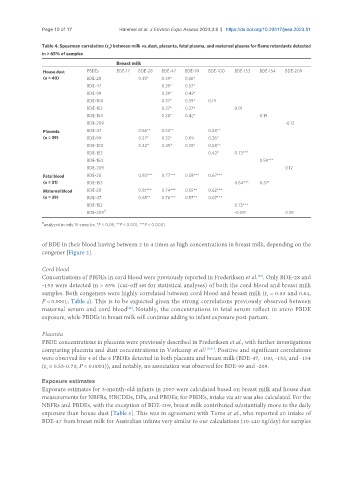
               Table 4. Spearman correlation (r ) between milk vs. dust, placenta, fetal plasma, and maternal plasma for flame retardants detected
                                      s
               in > 65% of samples
                                        Breast milk
                House dust    PBDEs     BDE-17  BDE-28  BDE-47  BDE-99  BDE-100  BDE-153  BDE-154  BDE-209
                (n = 40)      BDE-28            0.35*   0.39*  0.36*
                              BDE-47                    0.39*  0.37*
                              BDE-99                    0.39*  0.42*
                              BDE-100                   0.37*  0.39*   0.19
                              BDE-153                   0.37*  0.37*            0.01
                              BDE-154                   0.38*  0.42*                     0.19
                              BDE-209                                                            -0.12
                Placenta      BDE-47            0.56**  0.53**         0.58**
                (n = 39)      BDE-99            0.37*   0.32*  0.09    0.36*
                              BDE-100           0.42*   0.45*  0.38*   0.58**
                              BDE-153                                  0.42*    0.73***
                              BDE-154                                                    0.59***
                              BDE-209                                                            0.12
                Fetal blood   BDE-28            0.83***  0.77***  0.58***  0.67***
                (n = 31)      BDE-153                                           0.64***  0.37*
                Maternal blood   BDE-28         0.81***  0.74***  0.55**  0.62***
                (n = 39)      BDE-47            0.65**  0.76***  0.57**  0.67***
                              BDE-153                                           0.73***
                                    #
                              BDE-209                                           -0.59*           0.39
               #
                analyzed in only 15 samples. *P < 0.05, **P < 0.001, ***P < 0.0001.

               of BDE in their blood having between 2 to 4 times as high concentrations in breast milk, depending on the
               congener [Figure 2].


               Cord blood
               Concentrations of PBDEs in cord blood were previously reported in Frederiksen et al. . Only BDE-28 and
                                                                                        [42]
               -153 were detected in > 65% (cut-off set for statistical analyses) of both the cord blood and breast milk
               samples. Both congeners were highly correlated between cord blood and breast milk (r  = 0.83 and 0.64,
                                                                                           s
               P < 0.0001; Table 4). This is to be expected given the strong correlations previously observed between
               maternal serum and cord blood . Notably, the concentrations in fetal serum reflect in utero PBDE
                                            [42]
               exposure, while PBDEs in breast milk will continue adding to infant exposure post-partum.


               Placenta
               PBDE concentrations in placenta were previously described in Frederiksen et al., with further investigations
               comparing placenta and dust concentrations in Vorkamp et al. [15,41] . Positive and significant correlations
               were observed for 4 of the 6 PBDEs detected in both placenta and breast milk (BDE-47, -100, -153, and -154
               (r  = 0.53-0.73; P < 0.0001)), and notably, no association was observed for BDE-99 and -209.
                 s

               Exposure estimates
               Exposure estimates for 3-month-old infants in 2007 were calculated based on breast milk and house dust
               measurements for NBFRs, HBCDDs, DPs, and PBDEs; for PBDEs, intake via air was also calculated. For the
               NBFRs and PBDEs, with the exception of BDE-209, breast milk contributed substantially more to the daily
               exposure than house dust [Table 5]. This was in agreement with Toms et al., who reported an intake of
               BDE-47 from breast milk for Australian infants very similar to our calculations (10-440 ng/day) for samples

