


Page 49 - Read Online
P. 49
Page 518                          Liu et al. Intell Robot 2024;4(4):503-23  I http://dx.doi.org/10.20517/ir.2024.29


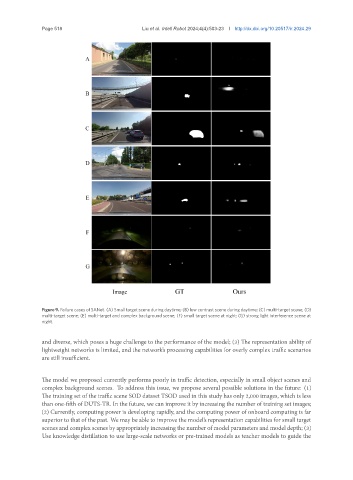
               Figure 9. Failure cases of SANet. (A) Small target scene during daytime; (B) low contrast scene during daytime; (C) multi-target scene; (D)
               multi-target scene; (E) multi-target and complex background scene; (F) small target scene at night; (G) strong light interference scene at
               night.


               and diverse, which poses a huge challenge to the performance of the model; (3) The representation ability of
               lightweight networks is limited, and the network’s processing capabilities for overly complex traffic scenarios
               are still insufficient.


               The model we proposed currently performs poorly in traffic detection, especially in small object scenes and
               complex background scenes. To address this issue, we propose several possible solutions in the future: (1)
               The training set of the traffic scene SOD dataset TSOD used in this study has only 2,000 images, which is less
               than one-fifth of DUTS-TR. In the future, we can improve it by increasing the number of training set images;
               (2) Currently, computing power is developing rapidly, and the computing power of onboard computing is far
               superior to that of the past. We may be able to improve the model’s representation capabilities for small target
               scenes and complex scenes by appropriately increasing the number of model parameters and model depth; (3)
               Use knowledge distillation to use large-scale networks or pre-trained models as teacher models to guide the

