


Page 48 - Read Online
P. 48
Liu et al. Intell Robot 2024;4(4):503-23  I http://dx.doi.org/10.20517/ir.2024.29   Page 517


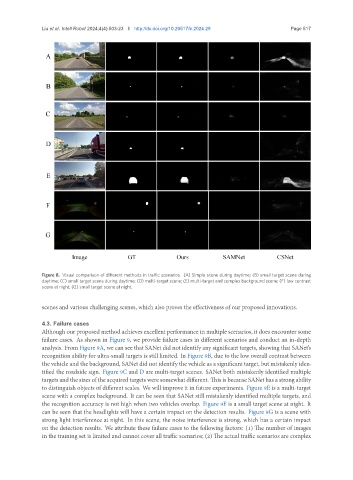
               Figure 8. Visual comparison of different methods in traffic scenarios. (A) Simple scene during daytime; (B) small target scene during
               daytime; (C) small target scene during daytime; (D) multi-target scene; (E) multi-target and complex background scene; (F) low contrast
               scene at night; (G) small target scene at night.


               scenes and various challenging scenes, which also proves the effectiveness of our proposed innovations.


               4.3. Failure cases
               Although our proposed method achieves excellent performance in multiple scenarios, it does encounter some
               failure cases. As shown in Figure 9, we provide failure cases in different scenarios and conduct an in-depth
               analysis. From Figure 9A, we can see that SANet did not identify any significant targets, showing that SANet’s
               recognition ability for ultra-small targets is still limited. In Figure 9B, due to the low overall contrast between
               the vehicle and the background, SANet did not identify the vehicle as a significant target, but mistakenly iden-
               tified the roadside sign. Figure 9C and D are multi-target scenes. SANet both mistakenly identified multiple
               targets and the sizes of the acquired targets were somewhat different. This is because SANet has a strong ability
               to distinguish objects of different scales. We will improve it in future experiments. Figure 9E is a multi-target
               scene with a complex background. It can be seen that SANet still mistakenly identified multiple targets, and
               the recognition accuracy is not high when two vehicles overlap. Figure 9F is a small target scene at night. It
               can be seen that the headlights will have a certain impact on the detection results. Figure 9G is a scene with
               strong light interference at night. In this scene, the noise interference is strong, which has a certain impact
               on the detection results. We attribute these failure cases to the following factors: (1) The number of images
               in the training set is limited and cannot cover all traffic scenarios; (2) The actual traffic scenarios are complex

