


Page 237 - Read Online
P. 237
Shami-shah et al. Extracell Vesicles Circ Nucleic Acids 2023;4:447-60  https://dx.doi.org/10.20517/evcna.2023.14  Page 457

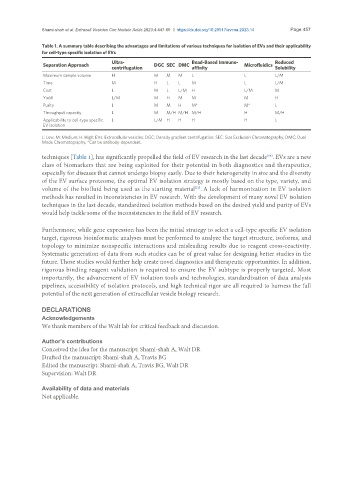
               Table 1. A summary table describing the advantages and limitations of various techniques for isolation of EVs and their applicability
               for cell-type specific isolation of EVs
                                       Ultra-                     Bead-Based Immuno-          Reduced
                Separation Approach                  DGC SEC DMC                   Microfluidics
                                       centrifugation             affinity                    Solubility
                Maximum sample volume  H             M   M   M    L                L          L/M
                Time                   M             H   L   L    M                L          L/M
                Cost                   L             M   L   L/M  H                L/M        M
                Yield                  L/M           M   H   M    M                M          H
                Purity                 L             M   M   H    M*               M*         L
                Throughput capacity    L             M   M/H M/H M/H               H          M/H
                Applicability to cell-type specific   L  L/M H  H  H               H          L
                EV isolation
               L: Low; M: Medium; H: High; EVs: Extracellular vesicles; DGC: Density gradient centrifugation; SEC: Size Exclusion Chromatography; DMC: Dual
               Mode Chromatography. *Can be antibody-dependent.
               techniques [Table 1], has significantly propelled the field of EV research in the last decade . EVs are a new
                                                                                           [66]
               class of biomarkers that are being exploited for their potential in both diagnostics and therapeutics,
               especially for diseases that cannot undergo biopsy easily. Due to their heterogeneity in size and the diversity
               of the EV surface proteome, the optimal EV isolation strategy is mostly based on the type, variety, and
                                                                   [21]
               volume of the biofluid being used as the starting material . A lack of harmonization in EV isolation
               methods has resulted in inconsistencies in EV research. With the development of many novel EV isolation
               techniques in the last decade, standardized isolation methods based on the desired yield and purity of EVs
               would help tackle some of the inconsistencies in the field of EV research.


               Furthermore, while gene expression has been the initial strategy to select a cell-type specific EV isolation
               target, rigorous bioinformatic analyses must be performed to analyze the target structure, isoforms, and
               topology to minimize nonspecific interactions and misleading results due to reagent cross-reactivity.
               Systematic generation of data from such studies can be of great value for designing better studies in the
               future. Those studies would further help create novel diagnostics and therapeutic opportunities. In addition,
               rigorous binding reagent validation is required to ensure the EV subtype is properly targeted. Most
               importantly, the advancement of EV isolation tools and technologies, standardization of data analysis
               pipelines, accessibility of isolation protocols, and high technical rigor are all required to harness the full
               potential of the next generation of extracellular vesicle biology research.


               DECLARATIONS
               Acknowledgements
               We thank members of the Walt lab for critical feedback and discussion.

               Author’s contributions
               Conceived the idea for the manuscript: Shami-shah A, Walt DR
               Drafted the manuscript: Shami-shah A, Travis BG
               Edited the manuscript: Shami-shah A, Travis BG, Walt DR
               Supervision: Walt DR

               Availability of data and materials
               Not applicable.

