


Page 232 - Read Online
P. 232
Page 452           Shami-shah et al. Extracell Vesicles Circ Nucleic Acids 2023;4:447-60  https://dx.doi.org/10.20517/evcna.2023.14


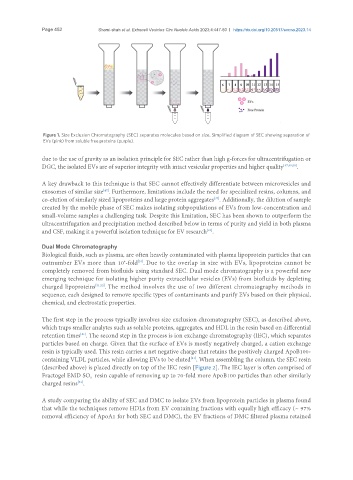
                Figure 1. Size Exclusion Chromatography (SEC) separates molecules based on size. Simplified diagram of SEC showing separation of
                EVs (pink) from soluble free proteins (purple).


               due to the use of gravity as an isolation principle for SEC rather than high g-forces for ultracentrifugation or
               DGC, the isolated EVs are of superior integrity with intact vesicular properties and higher quality [47,49,50] .


               A key drawback to this technique is that SEC cannot effectively differentiate between microvesicles and
                                    [47]
               exosomes of similar size . Furthermore, limitations include the need for specialized resins, columns, and
               co-elution of similarly sized lipoproteins and large protein aggregates . Additionally, the dilution of sample
                                                                         [37]
               created by the mobile phase of SEC makes isolating subpopulations of EVs from low-concentration and
               small-volume samples a challenging task. Despite this limitation, SEC has been shown to outperform the
               ultracentrifugation and precipitation method described below in terms of purity and yield in both plasma
               and CSF, making it a powerful isolation technique for EV research .
                                                                       [24]
               Dual Mode Chromatography
               Biological fluids, such as plasma, are often heavily contaminated with plasma lipoprotein particles that can
                                               [51]
               outnumber EVs more than 10 -fold . Due to the overlap in size with EVs, lipoproteins cannot be
                                           4
               completely removed from biofluids using standard SEC. Dual mode chromatography is a powerful new
               emerging technique for isolating higher purity extracellular vesicles (EVs) from biofluids by depleting
               charged lipoproteins [51,52] . The method involves the use of two different chromatography methods in
               sequence, each designed to remove specific types of contaminants and purify EVs based on their physical,
               chemical, and electrostatic properties.

               The first step in the process typically involves size exclusion chromatography (SEC), as described above,
               which traps smaller analytes such as soluble proteins, aggregates, and HDL in the resin based on differential
               retention times . The second step in the process is ion exchange chromatography (IEC), which separates
                            [51]
               particles based on charge. Given that the surface of EVs is mostly negatively charged, a cation exchange
               resin is typically used. This resin carries a net negative charge that retains the positively charged ApoB100-
                                                                 [51]
               containing VLDL particles, while allowing EVs to be eluted . When assembling the column, the SEC resin
               (described above) is placed directly on top of the IEC resin [Figure 2]. The IEC layer is often comprised of
               Fractogel EMD SO  resin capable of removing up to 70-fold more ApoB100 particles than other similarly
                                -
                               3
               charged resins .
                           [51]
               A study comparing the ability of SEC and DMC to isolate EVs from lipoprotein particles in plasma found
               that while the techniques remove HDLs from EV containing fractions with equally high efficacy (~ 97%
               removal efficiency of ApoA1 for both SEC and DMC), the EV fractions of DMC filtered plasma retained

