


Page 234 - Read Online
P. 234
Page 4 of 33           Girase et al. Energy Mater. 2025, 5, 500132  https://dx.doi.org/10.20517/energymater.2025.14

               absorption, exceptionally high photochemical stability, high thermal stability, functionalized groups, and
                                         [42]
               tunable semiconductivity, etc. . Numerous DPP derivatives that have been reported in studies are either
               small molecules or polymers that exhibit exceptional power conversion efficiency (PCE) or high
               charge-carrier mobility in organic solar cell and OFETs [28,29,43-47] . It has been more than two decades since
               several reviews on DPP-based materials have been reported. Nonetheless, most of these reviews concentrate
               on the sensing, synthesis, imaging and optoelectronic applications of small molecules and conjugated
               polymers based on DPP [48-54] . An extensive review of the DPP-based derivatives of their TE application is still
               lacking.

               DPP-based TE materials offer several advantages over conventional TE polymeric materials. DPP units
               possess a rigid, planar structure that facilitates strong π-π stacking interaction between polymer chains,
                                                                              [55]
               leading to high charge carrier mobility and, consequently, enhanced σ . Additionally, the electronic
               properties of DPP polymers can be readily tuned through chemical modifications, such as varying the side
               chains,  incorporating  electron-donating/withdrawing  groups,  and  copolymerization  with  other
               monomers  as shown in Figure 2. Furthermore, many DPP polymers exhibit excellent thermal stability
                        [56]
               and can be processed using solution-based techniques, enabling the fabrication of flexible and low-cost TE
               devices.


               The main objective of this review is to give a comprehensive overview of recent advancements in the TE
               materials, mainly focused on DPP-based donor-acceptor p-type and n-type copolymers. More specifically,
               the structure-property relationship, along with the strategies we have explored to enhance performance.
               Furthermore, we will introduce results and comparisons of different strategies aimed at improving TE
               performance, providing a comprehensive overview of achievements and ongoing challenges in this exciting
               field.


               THEORY OF THERMOELECTRIC
               The intrinsic property of materials to generate power from heat truly opens up the potential to harvest
               low-grade waste heat and convert it to electricity based on the Seebeck effect as shown in Figure 3A . This
                                                                                                   [57]
               effect was observed by the German scientist Thomas J. Seebeck in 1821, and it can find wide applicability in
               energy conversion [58,59] . The working principle of the TE energy-harvesting mechanism, if a temperature
               gradient (ΔT) is supplied, an electrostatic potential ΔV will be developed since the charge carriers-electrons
               for n-type materials or holes for p-type materials-will diffuse from the hot end to the cold end . Similarly,
                                                                                               [60]
               TE materials can also transform electrical energy into thermal energy based on the Peltier effect, as shown
               in Figure 3B; this effect is the reverse of the Seebeck effect. This effect was discovered a few years later in
               1834 by French scientist Jean Charles Athanase Peltier. He noticed that an electric current flowing through a
               junction of different materials transfers heat to or from that junction [61,62] .

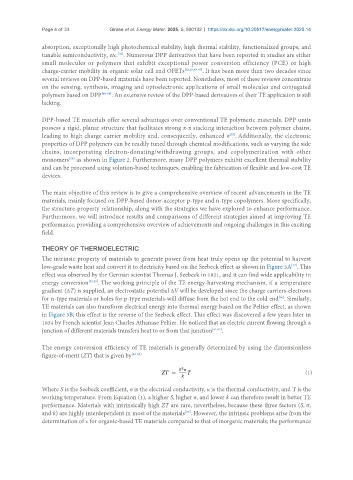
               The energy conversion efficiency of TE materials is generally determined by using the dimensionless
               figure-of-merit (ZT) that is given by [63-65]


                                                                                                        (1)

               Where S is the Seebeck coefficient, σ is the electrical conductivity, κ is the thermal conductivity, and T is the
               working temperature. From Equation (1), a higher S, higher σ, and lower k can therefore result in better TE
               performance. Materials with intrinsically high ZT are rare, nevertheless, because these three factors (S, σ,
                                                               [66]
               and k) are highly interdependent in most of the materials . However, the intrinsic problems arise from the
               determination of κ for organic-based TE materials compared to that of inorganic materials; the performance

