


Page 233 - Read Online
P. 233
Girase et al. Energy Mater. 2025, 5, 500132  https://dx.doi.org/10.20517/energymater.2025.14  Page 3 of 33


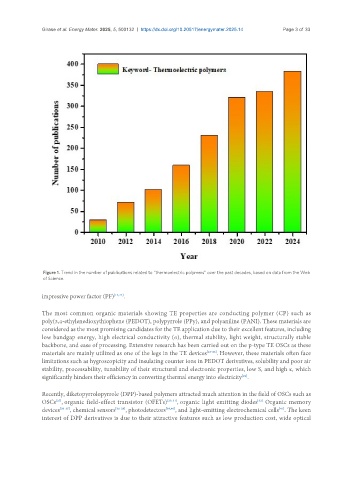
                Figure 1. Trend in the number of publications related to “thermoelectric polymers” over the past decades, based on data from the Web
                of Science.


               impressive power factor (PF) [14,22] .

               The most common organic materials showing TE properties are conducting polymer (CP) such as
               poly(3,4-ethylenedioxythiophene (PEDOT), polypyrrole (PPy), and polyaniline (PANI). These materials are
               considered as the most promising candidates for the TE application due to their excellent features, including
               low bandgap energy, high electrical conductivity (σ), thermal stability, light weight, structurally stable
               backbone, and ease of processing. Extensive research has been carried out on the p-type TE OSCs as these
               materials are mainly utilized as one of the legs in the TE devices [23-26] . However, these materials often face
               limitations such as hygroscopicity and insulating counter ions in PEDOT derivatives, solubility and poor air
               stability, processability, tunability of their structural and electronic properties, low S, and high κ, which
               significantly hinders their efficiency in converting thermal energy into electricity .
                                                                                   [22]

               Recently, diketopyrrolopyrrole (DPP)-based polymers attracted much attention in the field of OSCs such as
                    [27]
                                                                                        [32]
               OSCs , organic field-effect transistor (OFETs) [28-31] , organic light emitting diodes  Organic memory
               devices [33-35] , chemical sensors [36-38] , photodetectors [39,40] , and light-emitting electrochemical cells . The keen
                                                                                               [41]
               interest of DPP derivatives is due to their attractive features such as low production cost, wide optical

