


Page 225 - Read Online
P. 225
Kautsar et al. Energy Mater. 2025, 5, 500129  https://dx.doi.org/10.20517/energymater.2025.26  Page 9 of 14


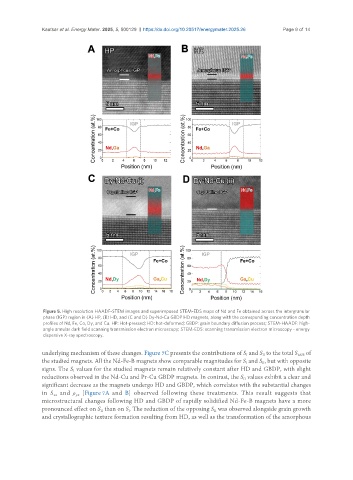
                Figure 5. High resolution HAADF-STEM images and superimposed STEM-EDS maps of Nd and Fe obtained across the intergranular
                phase (IGP) region in (A) HP, (B) HD, and (C and D) Dy-Nd-Cu GBDP HD magnets, along with the corresponding concentration depth
                profiles of Nd, Fe, Co, Dy, and Cu. HP: Hot-pressed; HD: hot-deformed; GBDP: grain boundary diffusion process; STEM-HAADF: high-
                angle annular dark field scanning transmission electron microscopy; STEM-EDS: scanning transmission electron microscopy - energy
                dispersive X-ray spectroscopy.


               underlying mechanism of these changes. Figure 7C presents the contributions of S  and S  to the total S  of
                                                                                          II
                                                                                    I
                                                                                                     ANE
               the studied magnets. All the Nd-Fe-B magnets show comparable magnitudes for S  and S , but with opposite
                                                                                    I
                                                                                         II
               signs. The S  values for the studied magnets remain relatively constant after HD and GBDP, with slight
                          I
               reductions observed in the Nd-Cu and Pr-Cu GBDP magnets. In contrast, the S  values exhibit a clear and
                                                                                   II
               significant decrease as the magnets undergo HD and GBDP, which correlates with the substantial changes
               in  S   and  ρ   [Figure 7A  and  B]  observed  following  these  treatments.  This  result  suggests  that
                           yx
                   xx
               microstructural changes following HD and GBDP of rapidly solidified Nd-Fe-B magnets have a more
               pronounced effect on S  than on S . The reduction of the opposing S  was observed alongside grain growth
                                            I
                                   II
                                                                         II
               and crystallographic texture formation resulting from HD, as well as the transformation of the amorphous

