


Page 224 - Read Online
P. 224
Page 8 of 14          Kautsar et al. Energy Mater. 2025, 5, 500129  https://dx.doi.org/10.20517/energymater.2025.26


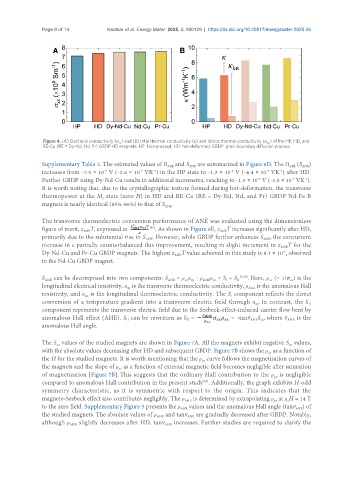
                Figure 4. (A) Electrical conductivity (σ ) and (B) total thermal conductivity (κ) and lattice thermal conductivity (κ ) of the HP, HD, and
                                                                                           lat
                                         xx
                RE-Cu (RE = Dy-Nd, Nd, Pr) GBDP HD magnets. HP: Hot-pressed; HD: hot-deformed; GBDP: grain boundary diffusion process.
               Supplementary Table 2. The estimated values of Π  and S  are summarized in Figure 6D. The Π  (S )
                                                                 ANE
                                                         AEE
                                                                                                       ANE
                                                                                                   AEE
               increases from -7.9 × 10  V (-2.6 × 10  VK ) in the HP state to -1.3 × 10  V (-4.4 × 10  VK ) after HD.
                                    -5
                                                -7
                                                                                           -7
                                                                                               -1
                                                     -1
                                                                               -4
                                                                                                   -7
                                                                                        -4
                                                                                                        -1
               Further GBDP using Dy-Nd-Cu results in additional increments, reaching to -1.5 × 10  V (-5.0 × 10  VK ).
               It is worth noting that, due to the crystallographic texture formed during hot-deformation, the transverse
               thermopower at the M  state (zero H) in HD and RE-Cu (RE = Dy-Nd, Nd, and Pr) GBDP Nd-Fe-B
                                    r
               magnets is nearly identical (85%-86%) to that of S .
                                                         ANE
               The transverse thermoelectric conversion performance of ANE was evaluated using the dimensionless
                                                   [45]
               figure of merit, z T, expressed as                . As shown in Figure 6E, z T increases significantly after HD,
                             ANE
                                                                           ANE
               primarily due to the substantial rise in S . However, while GBDP further enhances S , the concurrent
                                                                                          ANE
                                                  ANE
               increase in κ partially counterbalanced this improvement, resulting in slight increment in z T for the
                                                                                                ANE
               Dy-Nd-Cu and Pr-Cu GBDP magnets. The highest z T value achieved in this study is 8.1 × 10 , observed
                                                                                                -6
                                                            ANE
               in the Nd-Cu GBDP magnet.
                                                                        α  ≡ S  + S
               S  can be decomposed into two components: S  = ρ α  - ρ AHE xx  I  II [6,28] . Here, ρ  (= 1/σ ) is the
                                                          ANE
                                                                                            xx
                                                               xx xy
                                                                                                   xx
                ANE
               longitudinal electrical resistivity, α  is the transverse thermoelectric conductivity, ρ  is the anomalous Hall
                                                                                     AHE
                                            xy
               resistivity, and α  is the longitudinal thermoelectric conductivity. The S  component reflects the direct
                                                                               I
                              xx
               conversion of a temperature gradient into a transverse electric field through α . In contrast, the S II
                                                                                       xy
               component represents the transverse electric field due to the Seebeck-effect-induced carrier flow bent by
               anomalous Hall effect (AHE). S  can be rewritten as S  =                  = -tanθ S , where θ  is the
                                                                                     AHE xx
                                                                                                  AHE
                                                                II
                                            II
               anomalous Hall angle.
               The S  values of the studied magnets are shown in Figure 7A. All the magnets exhibit negative S  values,
                                                                                                  xx
                    xx
               with the absolute values decreasing after HD and subsequent GBDP. Figure 7B shows the ρ  as a function of
                                                                                           yx
               the H for the studied magnets. It is worth mentioning that the ρ  curve follows the magnetization curves of
                                                                     yx
               the magnets and the slope of ρ  as a function of external magnetic field becomes negligible after saturation
                                         yx
               of magnetization [Figure 7B]. This suggests that the ordinary Hall contribution to the ρ  is negligible
                                                                                             yx
               compared to anomalous Hall contribution in the present study . Additionally, the graph exhibits H-odd
                                                                     [58]
               symmetry  characteristic,  as  it  is  symmetric  with  respect  to  the  origin.  This  indicates  that  the
               magneto-Seebeck effect also contributes negligibly. The ρ  is determined by extrapolating ρ  at μ H = 14 T
                                                               AHE
                                                                                                  0
                                                                                             yx
               to the zero field. Supplementary Figure 5 presents the ρ  values and the anomalous Hall angle (tanθ ) of
                                                                                                     AHE
                                                              AHE
               the studied magnets. The absolute values of ρ  and tanθ  are gradually decreased after GBDP. Notably,
                                                      AHE
                                                                AHE
               although ρ  slightly decreases after HD, tanθ  increases. Further studies are required to clarify the
                                                         AHE
                         AHE

