


Page 227 - Read Online
P. 227
Kautsar et al. Energy Mater. 2025, 5, 500129  https://dx.doi.org/10.20517/energymater.2025.26  Page 11 of 14


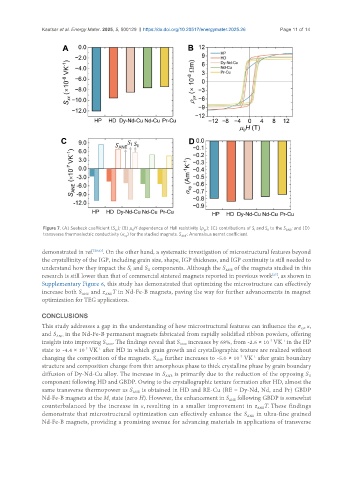
                Figure 7. (A) Seebeck coefficient (S ); (B) µ H dependence of Hall resistivity (ρ ); (C) contributions of S  and S  to the S  ; and (D)
                                        xx    0                       yx               I   II    ANE
                transverse thermoelectric conductivity (α ) for the studied magnets. S ANE : Anomalous nernst coefficient.
                                           xy
               demonstrated in ref. [28,61] . On the other hand, a systematic investigation of microstructural features beyond
               the crystallinity of the IGP, including grain size, shape, IGP thickness, and IGP continuity is still needed to
               understand how they impact the S  and S  components. Although the S  of the magnets studied in this
                                                   II
                                                                             ANE
                                             I
               research is still lower than that of commercial sintered magnets reported in previous work , as shown in
                                                                                             [27]
               Supplementary Figure 6, this study has demonstrated that optimizing the microstructure can effectively
               increase both S  and z T in Nd-Fe-B magnets, paving the way for further advancements in magnet
                                    ANE
                             ANE
               optimization for TEG applications.
               CONCLUSIONS
               This study addresses a gap in the understanding of how microstructural features can influence the σ , κ,
                                                                                                      xx
               and S  in the Nd-Fe-B permanent magnets fabricated from rapidly solidified ribbon powders, offering
                    ANE
                                                                                            -7
                                                                                                -1
               insights into improving S . The findings reveal that S  increases by 68%, from -2.6 × 10  VK  in the HP
                                     ANE
                                                              ANE
               state to -4.4 × 10  VK  after HD in which grain growth and crystallographic texture are realized without
                              -7
                                  -1
               changing the composition of the magnets. S  further increases to -5.0 × 10  VK  after grain boundary
                                                                                      -1
                                                                                  -7
                                                      ANE
               structure and composition change from thin amorphous phase to thick crystalline phase by grain boundary
               diffusion of Dy-Nd-Cu alloy. The increase in S  is primarily due to the reduction of the opposing S II
                                                         ANE
               component following HD and GBDP. Owing to the crystallographic texture formation after HD, almost the
               same transverse thermopower as S  is obtained in HD and RE-Cu (RE = Dy-Nd, Nd, and Pr) GBDP
                                              ANE
               Nd-Fe-B magnets at the M  state (zero H). However, the enhancement in S  following GBDP is somewhat
                                      r
                                                                              ANE
               counterbalanced by the increase in  κ, resulting in a smaller improvement in z T. These findings
                                                                                        ANE
               demonstrate that microstructural optimization can effectively enhance the S  in ultra-fine grained
                                                                                    ANE
               Nd-Fe-B magnets, providing a promising avenue for advancing materials in applications of transverse

