


Page 222 - Read Online
P. 222
Page 6 of 14          Kautsar et al. Energy Mater. 2025, 5, 500129  https://dx.doi.org/10.20517/energymater.2025.26


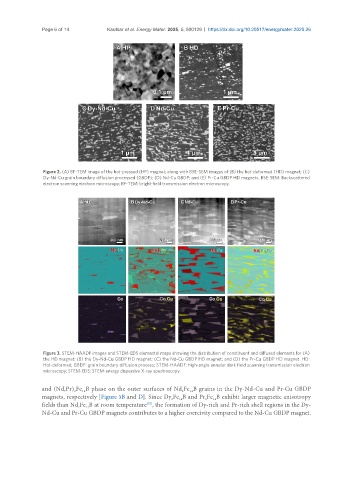
                Figure 2. (A) BF-TEM image of the hot-pressed (HP) magnet; along with BSE-SEM images of (B) the hot-deformed (HD) magnet; (C)
                Dy-Nd-Cu grain boundary diffusion processed (GBDP); (D) Nd-Cu GBDP; and (E) Pr-Cu GBDP HD magnets. BSE-SEM: Backscattered
                electron scanning electron microscopy; BF-TEM: bright-field transmission electron microscopy.


                Figure 3. STEM-HAADF images and STEM-EDS elemental maps showing the distribution of constituent and diffused elements for (A)
                the HD magnet; (B) the Dy-Nd-Cu GBDP HD magnet; (C) the Nd-Cu GBDP HD magnet; and (D) the Pr-Cu GBDP HD magnet. HD:
                Hot-deformed; GBDP: grain boundary diffusion process; STEM-HAADF: high-angle annular dark field scanning transmission electron
                microscopy; STEM-EDS: STEM-energy dispersive X-ray spectroscopy.

               and (Nd,Pr) Fe B phase on the outer surfaces of Nd Fe B grains in the Dy-Nd-Cu and Pr-Cu GBDP
                          2
                             14
                                                                 14
                                                              2
               magnets, respectively [Figure 3B and D]. Since Dy Fe B and Pr Fe B exhibit larger magnetic anisotropy
                                                             14
                                                           2
                                                                         14
                                                                      2
                                                  [52]
               fields than Nd Fe B at room temperature , the formation of Dy-rich and Pr-rich shell regions in the Dy-
                           2
                              14
               Nd-Cu and Pr-Cu GBDP magnets contributes to a higher coercivity compared to the Nd-Cu GBDP magnet.

