


Page 194 - Read Online
P. 194
Seo et al. Energy Mater. 2025, 5, 500123  https://dx.doi.org/10.20517/energymater.2025.38  Page 11 of 18


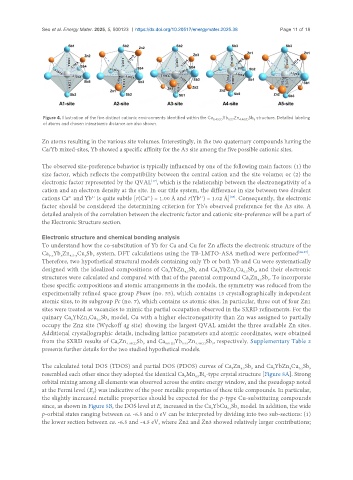
                Figure 4. Illustration of the five distinct cationic environments identified within the Ca 8.43(2) Yb 0.57 Zn 4.46(1) Sb  structure. Detailed labeling
                                                                                       9
                of atoms and chosen interatomic distance are also shown.

               Zn atoms resulting in the various site volumes. Interestingly, in the two quaternary compounds having the
               Ca/Yb mixed-sites, Yb showed a specific affinity for the A3 site among the five possible cationic sites.

               The observed site-preference behavior is typically influenced by one of the following main factors: (1) the
               size factor, which reflects the compatibility between the central cation and the site volume; or (2) the
               electronic factor represented by the QVAL , which is the relationship between the electronegativity of a
                                                    [17]
               cation and an electron density at the site. In our title system, the difference in size between two divalent
               cations Ca  and Yb  is quite subtle [r(Ca ) = 1.00 Å and r(Yb ) = 1.02 Å] . Consequently, the electronic
                                                   2+
                                2+
                                                                    2+
                                                                               [35]
                        2+
               factor should be considered the determining criterion for Yb's observed preference for the A3 site. A
               detailed analysis of the correlation between the electronic factor and cationic site-preference will be a part of
               the Electronic Structure section.
               Electronic structure and chemical bonding analysis
               To understand how the co-substitution of Yb for Ca and Cu for Zn affects the electronic structure of the
               Ca Yb Zn Cu Sb  system, DFT calculations using the TB-LMTO-ASA method were performed   [24-27] .
                                9
                              y
                     x
                         4.5-y
                 9-x
               Therefore, two hypothetical structural models containing only Yb or both Yb and Cu were systematically
               designed with the idealized compositions of Ca YbZn Sb  and Ca YbZn Cu Sb , and their electronic
                                                               4.5
                                                                   9
                                                                                       9
                                                          8
                                                                                   0.5
                                                                          8
                                                                                4
               structures were calculated and compared with that of the parental compound Ca Zn Sb . To incorporate
                                                                                           9
                                                                                        4.5
                                                                                     9
               these specific compositions and atomic arrangements in the models, the symmetry was reduced from the
               experimentally refined space group Pbam (no. 55), which contains 13 crystallographically independent
               atomic sites, to its subgroup Pc (no. 7), which contains 48 atomic sites. In particular, three out of four Zn1
               sites were treated as vacancies to mimic the partial occupation observed in the SXRD refinements. For the
               quinary Ca YbZn Cu Sb  model, Cu with a higher electronegativity than Zn was assigned to partially
                                     9
                         8
                              4
                                  0.5
               occupy the Zn2 site (Wyckoff 4g site) showing the largest QVAL amidst the three available Zn sites.
               Additional crystallographic details, including lattice parameters and atomic coordinates, were obtained
               from the SXRD results of Ca Zn 4.48(2) Sb  and Ca 8.01(3) Yb Zn 4.46(1) Sb , respectively. Supplementary Table 2
                                                                         9
                                                              0.99
                                                 9
                                         9
               presents further details for the two studied hypothetical models.
               The calculated total DOS (TDOS) and partial DOS (PDOS) curves of Ca Zn Sb  and Ca YbZn Cu Sb
                                                                                  4.5
                                                                               9
                                                                                      9
                                                                                                         9
                                                                                                   4
                                                                                                      0.5
                                                                                             8
               resembled each other since they adopted the identical Ca Mn Bi -type crystal structure [Figure 5A]. Strong
                                                                      9
                                                               9
                                                                   4.5
               orbital mixing among all elements was observed across the entire energy window, and the pseudogap noted
               at the Fermi level (E ) was indicative of the poor metallic properties of these title compounds. In particular,
                                F
               the slightly increased metallic properties should be expected for the p-type Cu-substituting compounds
               since, as shown in Figure 5B, the DOS level at E  increased in the Ca YbCu Sb  model. In addition, the wide
                                                       F
                                                                        8
                                                                                 9
                                                                              0.5
               p-orbital states ranging between ca. -6.5 and 0 eV can be interpreted by dividing into two sub-sections: (1)
               the lower section between ca. -6.5 and -4.5 eV, where Zn2 and Zn3 showed relatively larger contributions;

