


Page 193 - Read Online
P. 193
Page 10 of 18            Seo et al. Energy Mater. 2025, 5, 500123  https://dx.doi.org/10.20517/energymater.2025.38


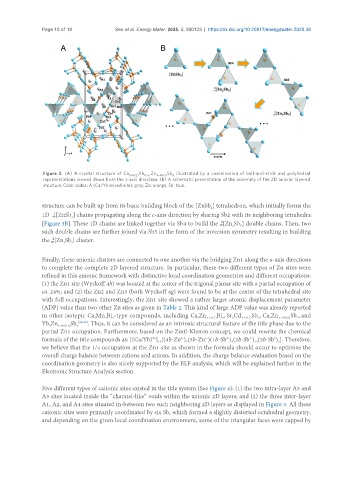
                Figure  3.  (A)  A  crystal  structure  of  Ca  Yb  Zn  Sb   illustrated  by  a  combination  of  ball-and-stick  and  polyhedral
                                            8.43(2)  0.57  4.46(1)  9
                representations viewed down from the c-axis direction. (B) A schematic presentation of the assembly of the 2D anionic layered
                structure. Color codes: A (Ca/Yb mixed-site): gray; Zn: orange; Sb: blue.

               structure can be built up from its basic building block of the [ZnSb ] tetrahedron, which initially forms the
                                                                        4
               1D   [ZnSb ] chains propagating along the c-axis direction by sharing Sb2 with its neighboring tetrahedra
                         3
               [Figure 3B]. These 1D chains are linked together via Sb4 to build the  [Zn Sb ] double chains. Then, two
                                                                               2
                                                                                  5
               such double chains are further joined via Sb5 in the form of the inversion symmetry resulting in building
               the  [Zn Sb ] cluster.
                         9
                      4
               Finally, these anionic clusters are connected to one another via the bridging Zn1 along the a-axis directions
               to complete the complete 2D layered structure. In particular, these two different types of Zn sites were
               refined in this anionic framework with distinctive local coordination geometries and different occupations:
               (1) the Zn1 site (Wyckoff 4h) was located at the center of the trigonal planar site with a partial occupation of
               ca. 24%; and (2) the Zn2 and Zn3 (both Wyckoff 4g) were found to be at the center of the tetrahedral site
               with full occupations. Interestingly, the Zn1 site showed a rather larger atomic displacement parameter
               (ADP) value than two other Zn sites as given in Table 2. This kind of large ADP value was already reported
               in other isotypic Ca Mn Bi -type compounds, including Ca Zn 4.10(1) Bi , Sr Cd 4.49(1) Sb , Ca Zn 4.478(8) Sb , and
                                 9
                                                                                                     9
                                                                    9
                                                                            9
                                                                               9
                                    4
                                       9
                                                                                        9
                                                                                            9
               Yb Zn 4.380(12) Sb 9 [33,34] . Thus, it can be considered as an intrinsic structural feature of the title phase due to the
                  9
               partial Zn1 occupation. Furthermore, based on the Zintl-Klemm concept, we could rewrite the chemical
                                                                                             0
                                                                             2-
                                                                      1-
                                                              2-
                                                                                     1-
                                                    2+
               formula of the title compounds as: [(Ca/Yb) ] [(4b-Zn ) (3b-Zn )(1b-Sb ) (2b-Sb ) (3b-Sb ) ]. Therefore,
                                                                                       13
                                                                                               2
                                                                               3
                                                      18
                                                                8
               we believe that the 1/4 occupation at the Zn1 site as shown in the formula should occur to optimize the
               overall charge balance between cations and anions. In addition, the charge balance evaluation based on the
               coordination geometry is also nicely supported by the ELF analysis, which will be explained further in the
               Electronic Structure Analysis section.
               Five different types of cationic sites existed in the title system (See Figure 4): (1) the two intra-layer A3 and
               A5 sites located inside the “channel-like” voids within the anionic 2D layers; and (2) the three inter-layer
               A1, A2, and A4 sites situated in-between two such neighboring 2D layers as displayed in Figure 3. All these
               cationic sites were primarily coordinated by six Sb, which formed a slightly distorted octahedral geometry,
               and depending on the given local coordination environment, some of the triangular faces were capped by

