Page 198 - Read Online
P. 198

Seo et al. Energy Mater. 2025, 5, 500123  https://dx.doi.org/10.20517/energymater.2025.38  Page 15 of 18


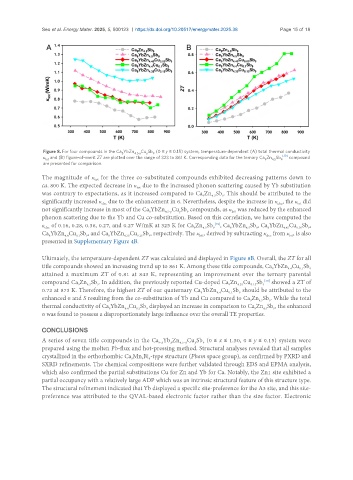
                Figure 8. For four compounds in the Ca YbZn 4.5-y Cu Sb  (0 ≤ y ≤ 0.15) system, temperature-dependent (A) total thermal conductivity
                                          8
                                                     9
                                                  y
                κ  and (B) figure-of-merit ZT are plotted over the range of 323 to 861 K. Corresponding data for the ternary Ca Zn Sb  9 [19]  compound
                tot
                                                                                          9
                                                                                             4.5
                are presented for comparison.
               The magnitude of κ  for the three co-substituted compounds exhibited decreasing patterns down to
                                 tot
               ca. 800 K. The expected decrease in κ  due to the increased phonon scattering caused by Yb substitution
                                               tot
               was contrary to expectations, as it increased compared to Ca Zn Sb . This should be attributed to the
                                                                     9
                                                                            9
                                                                        4.5
               significantly increased κ  due to the enhancement in σ. Nevertheless, despite the increase in κ , the κ  did
                                   elec
                                                                                               elec
                                                                                                     tot
               not significantly increase in most of the Ca YbZn Cu Sb  compounds, as κ  was reduced by the enhanced
                                                                9
                                                             y
                                                         4.5-y
                                                                               latt
                                                   8
               phonon scattering due to the Yb and Cu co-substitution. Based on this correlation, we have computed the
                                                                         [19]
               κ  of 0.16, 0.28, 0.36, 0.27, and 0.27 W/mK at 325 K for Ca Zn Sb , Ca YbZn Sb , Ca YbZn Cu Sb ,
                                                                                                         9
                                                                  9
                                                                                           8
                                                                         9
                                                                               8
                                                                                       9
                                                                                    4.5
                                                                                                 4.45
                                                                                                     0.05
                                                                     4.5
                elec
               Ca YbZn Cu Sb , and Ca YbZn Cu Sb , respectively. The κ , derived by subtracting κ  from κ , is also
                                               0.15
                                                                                           elec
                                                                                                   tot
                                                   9
                                                                    latt
                 8
                                      8
                              9
                           0.1
                       4.4
                                           4.35
               presented in Supplementary Figure 4B.
               Ultimately, the temperature-dependent ZT was calculated and displayed in Figure 8B. Overall, the ZT for all
               title compounds showed an increasing trend up to 861 K. Among these title compounds, Ca YbZn Cu Sb 9
                                                                                             8
                                                                                                      0.1
                                                                                                  4.4
               attained a maximum ZT of 0.81 at 843 K, representing an improvement over the ternary parental
               compound Ca Zn Sb . In addition, the previously reported Cu-doped Ca Zn Cu Sb  showed a ZT of
                                                                                          [38]
                                                                                 4.35
                                                                                      0.15
                                                                              9
                              4.5
                                  9
                                                                                          9
                           9
               0.72 at 873 K. Therefore, the highest ZT of our quaternary Ca YbZn Cu Sb  should be attributed to the
                                                                              0.1
                                                                                  9
                                                                          4.4
                                                                     8
               enhanced σ and S resulting from the co-substitution of Yb and Cu compared to Ca Zn Sb . While the total
                                                                                            9
                                                                                        4.5
                                                                                     9
               thermal conductivity of Ca YbZn Cu Sb  displayed an increase in comparison to Ca Zn Sb , the enhanced
                                                                                       9
                                               0.1
                                                                                          4.5
                                                  9
                                      8
                                                                                             9
                                           4.4
               σ was found to possess a disproportionately large influence over the overall TE properties.
               CONCLUSIONS
               A series of seven title compounds in the Ca Yb Zn Cu Sb  (0 ≤ x ≤ 1.50, 0 ≤ y ≤ 0.15) system were
                                                                     9
                                                      9-x
                                                          x
                                                              4.5-y
                                                                   y
               prepared using the molten Pb-flux and hot-pressing method. Structural analyses revealed that all samples
               crystallized in the orthorhombic Ca Mn Bi -type structure (Pbam space group), as confirmed by PXRD and
                                             9
                                                   9
                                                 4
               SXRD refinements. The chemical compositions were further validated through EDS and EPMA analysis,
               which also confirmed the partial substitutions Cu for Zn and Yb for Ca. Notably, the Zn1 site exhibited a
               partial occupancy with a relatively large ADP which was an intrinsic structural feature of this structure type.
               The structural refinement indicated that Yb displayed a specific site-preference for the A3 site, and this site-
               preference was attributed to the QVAL-based electronic factor rather than the size factor. Electronic
   193   194   195   196   197   198   199   200   201   202   203