


Page 15 - Read Online
P. 15
Page 10 of 20     Hamawandi et al. Energy Mater. 2025, 5, 500065  https://dx.doi.org/10.20517/energymater.2024.204

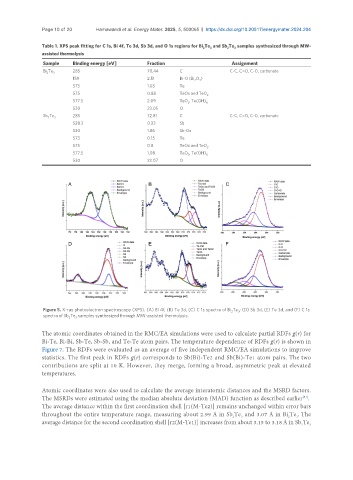
               Table 1. XPS peak fitting for C 1s, Bi 4f, Te 3d, Sb 3d, and O 1s regions for Bi Te  and Sb Te  samples synthesized through MW-
                                                                        3
                                                                     2
                                                                              2
                                                                                3
               assisted thermolysis
                Sample    Binding energy [eV]      Fraction                    Assignment
                Bi Te 3   285                      70.44      C                C-C, C=O, C-O, carbonate
                 2
                          159                      2.51       Bi-O (Bi O )
                                                                   2  3
                          573                      1.03       Te
                          575                      0.88       TeOx and TeO 2
                          577.5                    2.09       TeO , Te(OH) 6
                                                                3
                          530                      23.05      O
                Sb Te     285                      72.81      C                C-C, C=O, C-O, carbonate
                 2  3
                          528.3                    0.23       Sb
                          530                      1.86       Sb-Ox
                          573                      0.15       Te
                          575                      0.8        TeOx and TeO
                                                                       2
                          577.5                    1.08       TeO , Te(OH) 6
                                                                3
                          530                      23.07      O


                Figure 5. X-ray photoelectron spectroscopy (XPS). (A) Bi 4f, (B) Te 3d, (C) C 1s spectra of Bi Te ; (D) Sb 3d, (E) Te 3d, and (F) C 1s
                                                                               2
                                                                                 3
                spectra of Sb Te  samples synthesized through MW-assisted thermolysis.
                          3
                        2
               The atomic coordinates obtained in the RMC/EA simulations were used to calculate partial RDFs g(r) for
               Bi-Te, Bi-Bi, Sb-Te, Sb-Sb, and Te-Te atom pairs. The temperature dependence of RDFs g(r) is shown in
               Figure 7. The RDFs were evaluated as an average of five independent RMC/EA simulations to improve
               statistics. The first peak in RDFs g(r) corresponds to Sb(Bi)-Te2 and Sb(Bi)-Te1 atom pairs. The two
               contributions are split at 10 K. However, they merge, forming a broad, asymmetric peak at elevated
               temperatures.

               Atomic coordinates were also used to calculate the average interatomic distances and the MSRD factors.
               The MSRDs were estimated using the median absolute deviation (MAD) function as described earlier .
                                                                                                       [51]
               The average distance within the first coordination shell [r1(M-Te2)] remains unchanged within error bars
               throughout the entire temperature range, measuring about 2.99 Å in Sb Te  and 3.07 Å in Bi Te . The
                                                                                                  2
                                                                                                     3
                                                                               2
                                                                                  3
               average distance for the second coordination shell [r2(M-Te1)] increases from about 3.15 to 3.18 Å in Sb Te
                                                                                                         3
                                                                                                       2

