


Page 19 - Read Online
P. 19
Page 14 of 20     Hamawandi et al. Energy Mater. 2025, 5, 500065  https://dx.doi.org/10.20517/energymater.2024.204


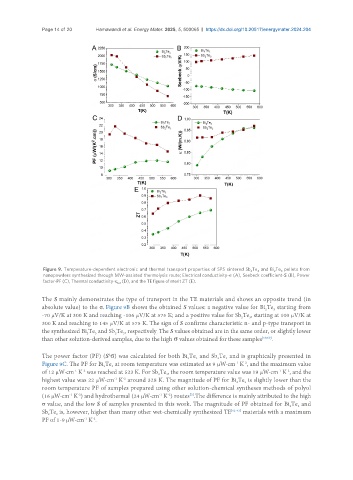
                Figure 9. Temperature-dependent electronic and thermal transport properties of SPS sintered Sb Te  and Bi Te  pellets from
                                                                                             2
                                                                                                3
                                                                                        3
                                                                                     2
                nanopowders synthesized through MW-assisted thermolysis route; Electrical conductivity-σ (A), Seebeck coefficient-S (B), Power
                factor-PF (C), Thermal conductivity-κ  (D), and the TE figure of merit ZT (E).
                                         tot
               The S mainly demonstrates the type of transport in the TE materials and shows an opposite trend (in
               absolute value) to the σ. Figure 9B shows the obtained S values: a negative value for Bi Te  starting from
                                                                                          2
                                                                                             3
               -70 µV/K at 300 K and reaching -106 µV/K at 575 K; and a positive value for Sb Te , starting at 100 µV/K at
                                                                                  2
                                                                                     3
               300 K and reaching to 145 µV/K at 575 K. The sign of S confirms characteristic n- and p-type transport in
               the synthesized Bi Te  and Sb Te , respectively The S values obtained are in the same order, or slightly lower
                                 3
                                                      .
                                        2
                                          3
                              2
               than other solution-derived samples, due to the high σ values obtained for these samples [59,60] .
                                      2
               The power factor (PF) (S σ) was calculated for both Bi Te  and Sb Te  and is graphically presented in
                                                                             3
                                                                   3
                                                                2
                                                                          2
               Figure 9C. The PF for Bi Te  at room temperature was estimated as 9 µW·cm  K , and the maximum value
                                                                                   -2
                                                                                -1
                                    2
                                       3
                                                                                               -1
               of 12 µW·cm  K  was reached at 523 K. For Sb Te , the room temperature value was 19 µW·cm  K , and the
                                                                                                  -2
                          -1
                             -2
                                                         3
                                                      2
                                          -2
                                       -1
               highest value was 22 µW·cm  K  around 328 K. The magnitude of PF for Bi Te  is slightly lower than the
                                                                                   3
                                                                                 2
               room temperature PF of samples prepared using other solution-chemical syntheses methods of polyol
               (16 μW·cm  K ) and hydrothermal (24 μW·cm  K ) routes .The difference is mainly attributed to the high
                                                                 [3]
                           -2
                                                       -1
                                                          -2
                        -1
               σ value, and the low S of samples presented in this work. The magnitude of PF obtained for Bi Te  and
                                                                                                     3
                                                                                                   2
               Sb Te  is, however, higher than many other wet-chemically synthesized TE [61-63]  materials with a maximum
                    3
                 2
               PF of 1-9 μW·cm  K .
                             -1
                                -2

