


Page 18 - Read Online
P. 18
Hamawandi et al. Energy Mater. 2025, 5, 500065  https://dx.doi.org/10.20517/energymater.2024.204  Page 13 of 20


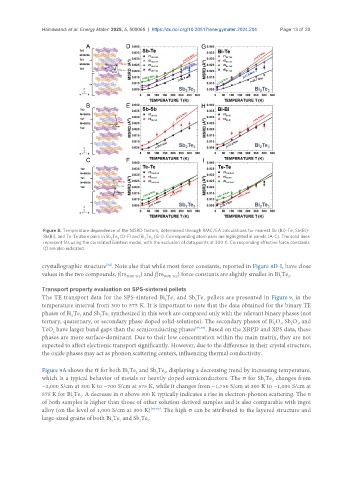
                Figure 8. Temperature dependence of the MSRD factors, determined through RMC/EA calculations for nearest Sb (Bi)-Te, Sb(Bi)-
                Sb(Bi), and Te-Te atom pairs in Sb Te  (D-F) and Bi Te  (G-I). Corresponding atom pairs are highlighted in panels (A-C). The solid lines
                                      2
                                                  2
                                                    3
                                         3
                represent fits using the correlated Einstein model, with the exclusion of data points at 300 K. Corresponding effective force constants
                (f) are also indicated.
               crystallographic structure . Note also that while most force constants, reported in Figure 8D-I, have close
                                     [54]
               values in the two compounds, f(r5 Sb/Bi-Te2 ) and f(r6 Sb/Bi-Te2 ) force constants are slightly smaller in Bi Te .
                                                                                                  3
                                                                                               2
               Transport property evaluation on SPS-sintered pellets
               The TE transport data for the SPS-sintered Bi Te  and Sb Te  pellets are presented in Figure 9, in the
                                                                      3
                                                         2
                                                                   2
                                                           3
               temperature interval from 300 to 575 K. It is important to note that the data obtained for the binary TE
               phases of Bi Te  and Sb Te  synthesized in this work are compared only with the relevant binary phases (not
                            3
                                   2
                                     3
                         2
               ternary, quaternary, or secondary phase doped solid-solutions). The secondary phases of Bi O , Sb O , and
                                                                                                3
                                                                                                   2
                                                                                                     3
                                                                                             2
               TeO  have larger band gaps than the semiconducting phases [55-57] . Based on the XRPD and XPS data, these
                   x
               phases are more surface-dominant. Due to their low concentration within the main matrix, they are not
               expected to affect electronic transport significantly. However, due to the difference in their crystal structure,
               the oxide phases may act as phonon scattering centers, influencing thermal conductivity.
               Figure 9A shows the σ for both Bi Te  and Sb Te , displaying a decreasing trend by increasing temperature,
                                            2
                                                      2
                                                        3
                                               3
               which is a typical behavior of metals or heavily doped semiconductors. The σ for Sb Te  changes from
                                                                                          2
                                                                                             3
               ~2,000 S/cm at 300 K to ~700 S/cm at 575 K, while it changes from ~1,750 S/cm at 300 K to ~1,000 S/cm at
               575 K for Bi Te . A decrease in σ above 300 K typically indicates a rise in electron-phonon scattering. The σ
                            3
                         2
               of both samples is higher than those of other solution-derived samples and is also comparable with ingot
               alloy (on the level of 1,000 S/cm at 300 K) [58-60] . The high σ can be attributed to the layered structure and
               large-sized grains of both Bi Te  and Sb Te .
                                                   3
                                         3
                                       2
                                                2

