


Page 21 - Read Online
P. 21
Page 16 of 20     Hamawandi et al. Energy Mater. 2025, 5, 500065  https://dx.doi.org/10.20517/energymater.2024.204


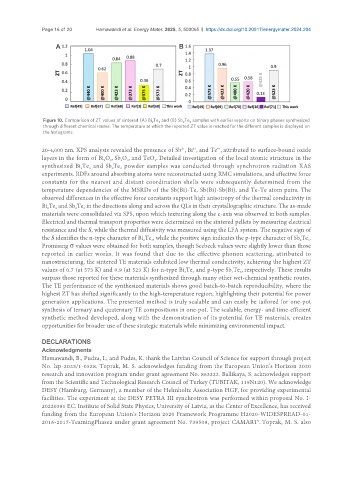
                Figure 10. Comparison of ZT values of sintered (A) Bi Te  and (B) Sb Te  samples with earlier reports on binary phases synthesized
                                                      3
                                                    2
                                                                 3
                                                               2
                through different chemical routes. The temperature at which the reported ZT value is reached for the different samples is displayed on
                the histograms.
                                                                          4+
                                                                  3+
                                                              3+
               20-4,000 nm. XPS analysis revealed the presence of Sb , Bi , and Te , attributed to surface-bound oxide
               layers in the form of Bi O , Sb O , and TeO . Detailed investigation of the local atomic structure in the
                                                     2
                                    2
                                            3
                                          2
                                      x
               synthesized Bi Te  and Sb Te  powder samples was conducted through synchrotron radiation XAS
                            2
                               3
                                       2
                                          3
               experiments. RDFs around absorbing atoms were reconstructed using RMC simulations, and effective force
               constants for the nearest and distant coordination shells were subsequently determined from the
               temperature dependencies of the MSRDs of the Sb(Bi)-Te, Sb(Bi)-Sb(Bi), and Te-Te atom pairs. The
               observed differences in the effective force constants support high anisotropy of the thermal conductivity in
               Bi Te  and Sb Te  in the directions along and across the QLs in their crystallographic structure. The as-made
                 2
                             3
                          2
                    3
               materials were consolidated via SPS, upon which texturing along the c-axis was observed in both samples.
               Electrical and thermal transport properties were determined on the sintered pellets by measuring electrical
               resistance and the S, while the thermal diffusivity was measured using the LFA system. The negative sign of
               the S identifies the n-type character of Bi Te , while the positive sign indicates the p-type character of Sb Te .
                                                 2
                                                                                                      2
                                                                                                         3
                                                    3
               Promising σ values were obtained for both samples, though Seebeck values were slightly lower than those
               reported in earlier works. It was found that due to the effective phonon scattering, attributed to
               nanostructuring, the sintered TE materials exhibited low thermal conductivity, achieving the highest ZT
               values of 0.7 (at 573 K) and 0.9 (at 523 K) for n-type Bi Te  and p-type Sb Te , respectively. These results
                                                                               2
                                                                                  3
                                                               2
                                                                  3
               surpass those reported for these materials synthesized through many other wet-chemical synthetic routes.
               The TE performance of the synthesized materials shows good batch-to-batch reproducibility, where the
               highest ZT has shifted significantly to the high-temperature region, highlighting their potential for power
               generation applications. The presented method is truly scalable and can easily be tailored for one-pot
               synthesis of ternary and quaternary TE compositions in one-pot. The scalable, energy- and time-efficient
               synthetic method developed, along with the demonstration of its potential for TE materials, creates
               opportunities for broader use of these strategic materials while minimizing environmental impact.
               DECLARATIONS
               Acknowledgments
               Hamawandi, B., Pudza, I., and Pudzs, K. thank the Latvian Council of Science for support through project
               No. lzp-2023/1-0528. Toprak, M. S. acknowledges funding from the European Union's Horizon 2020
               research and innovation program under grant agreement No. 863222. Ballikaya, S. acknowledges support
               from the Scientific and Technological Research Council of Turkey (TUBITAK, 119N120). We acknowledge
               DESY (Hamburg, Germany), a member of the Helmholtz Association HGF, for providing experimental
               facilities. The experiment at the DESY PETRA III synchrotron was performed within proposal No. I-
               20220381 EC. Institute of Solid State Physics, University of Latvia, as the Center of Excellence, has received
               funding from the European Union's Horizon 2020 Framework Programme H2020-WIDESPREAD-01-
               2016-2017-TeamingPhase2 under grant agreement No. 739508, project CAMART . Toprak, M. S. also
                                                                                        2

