


Page 199 - Read Online
P. 199
Page 10 of 23           Yang et al. Energy Mater 2024;4:400061  https://dx.doi.org/10.20517/energymater.2023.144


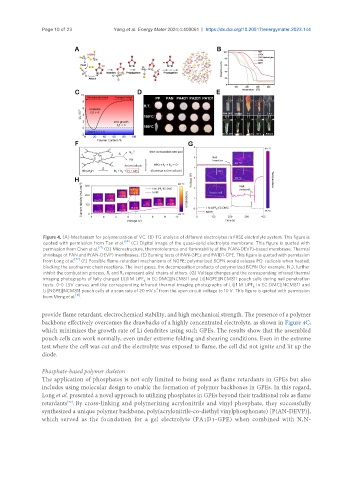
                Figure 4. (A) Mechanism for polymerization of VC. (B) TG analysis of different electrolytes in FRSE electrolyte system. This figure is
                quoted with permission from Tan et al. [69]  (C) Digital image of the quasi-solid electrolyte membrane. This figure is quoted with
                permission from Chen et al. [71]  (D) Microstructure, thermotolerance and flammability of the P(AN-DEVP)-based membrane. Thermal
                shrinkage of PAN and P(AN-DEVP) membranes. (E) Burning tests of PAN-GPEs and PA1D1-GPE. This figure is quoted with permission
                from Long et al. [72]  (F) Possible flame-retardant mechanisms of NGPE; polymerized BCPN would release PO· radicals when heated,
                blocking the exothermic chain reactions. The inert gases, the decomposition products of polymerized BCPN (for example, N ), further
                                                                                                   2
                inhibit the combustion process. R  and R  represent alkyl chains of ethers. (G) Voltage changes and the corresponding infrared thermal
                                      1
                                          2
                imaging photographs of fully charged Li||1 M LiPF  in EC:DMC||NCM811 and Li||NGPE||NCM811 pouch cells during nail penetration
                                                 6
                tests. (H) LSV curves and the corresponding infrared thermal imaging photographs of Li||1 M LiPF  in EC:DMC||NCM811 and
                                                                                      6
                                                      -1
                Li||NGPE||NCM811 pouch cells at a scan rate of 20 mV s  from the open circuit voltage to 10 V. This figure is quoted with permission
                from Meng et al. [16] .
               provide flame retardant, electrochemical stability, and high mechanical strength. The presence of a polymer
               backbone effectively overcomes the drawbacks of a highly concentrated electrolyte, as shown in Figure 4C,
               which minimizes the growth rate of Li dendrites using such GPEs. The results show that the assembled
               pouch cells can work normally, even under extreme folding and shearing conditions. Even in the extreme
               test where the cell was cut and the electrolyte was exposed to flame, the cell did not ignite and lit up the
               diode.

               Phosphate-based polymer skeleton
               The application of phosphates is not only limited to being used as flame retardants in GPEs but also
               includes using molecular design to enable the formation of polymer backbones in GPEs. In this regard,
               Long et al. presented a novel approach to utilizing phosphates in GPEs beyond their traditional role as flame
               retardants . By cross-linking and polymerizing acrylonitrile and vinyl phosphate, they successfully
                        [72]
               synthesized a unique polymer backbone, poly(acrylonitrile-co-diethyl vinylphosphonate) [P(AN-DEVP)],
               which  served  as  the  foundation  for  a  gel  electrolyte  (PA1D1-GPE)  when  combined  with  N,N-

