


Page 201 - Read Online
P. 201
Page 12 of 23           Yang et al. Energy Mater 2024;4:400061  https://dx.doi.org/10.20517/energymater.2023.144


               Fluorinated additives
               Currently, a viable strategy for achieving electrolyte nonflammability is to increase the fluorine content in
               electrolyte solvents. To improve the thermal stability of GPEs, it is feasible to introduce fluorinated solvents
               into the polymer matrix. Wu et al. have proposed an innovative approach to design a novel fluorinated
                                                               [76]
               electrolyte embedded in an organic polymer backbone . They prepared this fluorinated electrolyte by
               dissolving 1 M LiPF  in a mixture of fluorinated solvents, such as fluorinated EC (FEC), 2,2,2-trifluoroethyl
                                6
               carbonate and 1,1,2,3,3,3-hexafluoropropyl-2,2,2-trifluoroethyl ether [Figure 5A]. Subsequently, they
               formed fluorinated GPEs (HGPE) through in situ polymerization with the addition of 3 wt% of diethylallyl
               phosphate (DAP) and pentaerythritol tetraacrylate (PETEA). In linear scanning voltammetry (LSV) testing,
               the oxidation current of this GPE was as low as 5.8 V [Figure 5B]. This is attributed to the high oxidative
               stability of the fluorinated solvent, significantly enhancing the stability of this GPE under galvanic corrosion
               conditions. During the ignition test, HGPE exhibited zero SET, indicating excellent nonflammability due to
               the capture of hydrogen radicals by fluorine radicals, thereby reducing the risk of combustion. Furthermore,
               Li||Li RuO  (LRO) pouch cells assembled with HGPE showed no voltage and shape changes after aging at
                    2
                        3
               130 °C for 2,500 s, in contrast to the voltage changes and swelling of the cells assembled with LE starting in
               1,964 s [Figure 5C]. Additionally, HGPE exhibited high ionic conductivity (1.99 mS cm ) at room
                                                                                                -1
               temperature due to fluorinated solvents, confirming that it combines both high safety and high ionic
               conductivity.

               Fluorinated polymer backbone
               Introducing flame-retardant components into the polymer backbone can improve the thermal stability of
               GPEs to some extent. However, the thermal safety of GPEs still needs to be improved due to the use of
               conventional organic electrolytes. Hu et al. recently developed an innovative new polymer matrix using the
               fluorinated monomer hexafluorobutyl acrylate (HFBA) for in situ radical polymerization with a PETEA
                         [77]
               cross-linker . This approach transferred the conventional liquid-phase addition of fluorinated solvents to
               the polymer backbone. It does not require the addition of flame retardants, and possible flammability
               caused by liquid organic solvents is eliminated by the gas-phase radical scavenging action of HFBA.
               Consequently, the resulting GPEs do not necessitate additional flame retardants. This remarkable
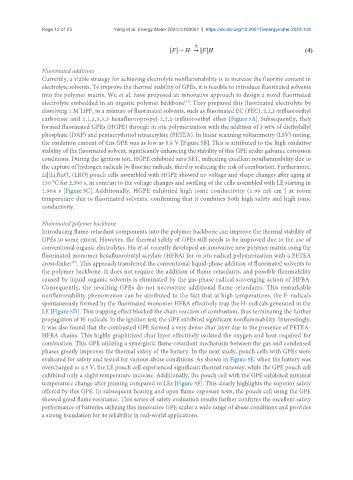
               nonflammability phenomenon can be attributed to the fact that at high temperatures, the F· radicals
               spontaneously formed by the fluorinated monomer HFBA effectively trap the H· radicals generated in the
               LE [Figure 5D]. This trapping effect blocked the chain reaction of combustion, thus terminating the further
               propagation of H· radicals. In the ignition test, the GPE exhibited significant nonflammability. Interestingly,
               it was also found that the combusted GPE formed a very dense char layer due to the presence of PETEA-
               HFBA chains. This highly graphitized char layer effectively isolated the oxygen and heat required for
               combustion. This GPE utilizing a synergistic flame-retardant mechanism between the gas and condensed
               phases greatly improves the thermal safety of the battery. In the next study, pouch cells with GPEs were
               evaluated for safety and tested for various abuse conditions. As shown in Figure 5E, when the battery was
               overcharged to 4.5 V, the LE pouch cell experienced significant thermal runaway, while the GPE pouch cell
               exhibited only a slight temperature increase. Additionally, the pouch cell with the GPE exhibited minimal
               temperature change after pinning compared to LEs [Figure 5F]. This clearly highlights the superior safety
               offered by this GPE. In subsequent heating and open flame exposure tests, the pouch cell using the GPE
               showed good flame resistance. This series of safety evaluation results further confirms the excellent safety
               performance of batteries utilizing this innovative GPE under a wide range of abuse conditions and provides
               a strong foundation for its reliability in real-world applications.

