


Page 204 - Read Online
P. 204
Yang et al. Energy Mater 2024;4:400061  https://dx.doi.org/10.20517/energymater.2023.144  Page 15 of 23


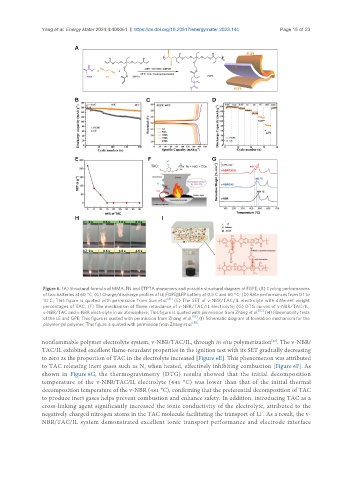
                Figure 6. (A) Structural formula of MMA, FN and ETPTA monomers and possible structural diagram of FGPE; (B) Cycling performances
                of two batteries at 60 °C; (C) Charge/discharge profiles of Li||FGPE||LFP battery at 0.5 C and 60 °C; (D) Rate performances from 0.1 to
                                                         [81]
                10 C; This figure is quoted with permission from Sun et al.   (E) The SET of v-NBR/TAC/IL electrolyte with different weight
                percentages of TAC; (F) The mechanism of flame retardance of v-NBR/TAC/IL electrolyte; (G) DTG curves of v-NBR/TAC/IL,
                                                                                        [82]
                v-NBR/TAC and v-NBR electrolyte in air atmosphere; This figure is quoted with permission from Zhang et al.   (H) Flammability tests
                                                                  [57]
                of the LE and GPE; This figure is quoted with permission from Zhang  et al.  ; (I) Schematic diagram of formation mechanism for the
                                                                  [85]
                polymer gel polymer; This figure is quoted with permission from Zhang et al.  .
               nonflammable polymer electrolyte system, v-NBR/TAC/IL, through in situ polymerization . The v-NBR/
                                                                                             [82]
               TAC/IL exhibited excellent flame-retardant properties in the ignition test with its SET gradually decreasing
               to zero as the proportion of TAC in the electrolyte increased [Figure 6E]. This phenomenon was attributed
               to TAC releasing inert gases such as N  when heated, effectively inhibiting combustion [Figure 6F]. As
                                                  2
               shown in Figure 6G, the thermogravimetry (DTG) results showed that the initial decomposition
               temperature of the v-NBR/TAC/IL electrolyte (441 °C) was lower than that of the initial thermal
               decomposition temperature of the v-NBR (481 °C), confirming that the preferential decomposition of TAC
               to produce inert gases helps prevent combustion and enhance safety. In addition, introducing TAC as a
               cross-linking agent significantly increased the ionic conductivity of the electrolyte, attributed to the
               negatively charged nitrogen atoms in the TAC molecule facilitating the transport of Li . As a result, the v-
                                                                                         +
               NBR/TAC/IL system demonstrated excellent ionic transport performance and electrode interface

