


Page 208 - Read Online
P. 208
Yang et al. Energy Mater 2024;4:400061  https://dx.doi.org/10.20517/energymater.2023.144  Page 19 of 23


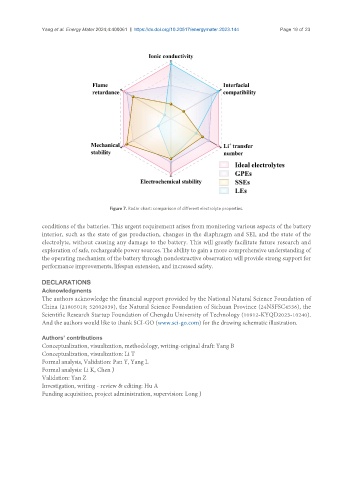
                                      Figure 7. Radar chart: comparison of different electrolyte properties.

               conditions of the batteries. This urgent requirement arises from monitoring various aspects of the battery
               interior, such as the state of gas production, changes in the diaphragm and SEI, and the state of the
               electrolyte, without causing any damage to the battery. This will greatly facilitate future research and
               exploration of safe, rechargeable power sources. The ability to gain a more comprehensive understanding of
               the operating mechanism of the battery through nondestructive observation will provide strong support for
               performance improvements, lifespan extension, and increased safety.


               DECLARATIONS
               Acknowledgments
               The authors acknowledge the financial support provided by the National Natural Science Foundation of
               China (21805018; 52002039), the Natural Science Foundation of Sichuan Province (24NSFSC4536), the
               Scientific Research Startup Foundation of Chengdu University of Technology (10912-KYQD2023-10240).
               And the authors would like to thank SCI-GO (www.sci-go.com) for the drawing schematic illustration.


               Authors’ contributions
               Conceptualization, visualization, methodology, writing-original draft: Yang B
               Conceptualization, visualization: Li T
               Formal analysis, Validation: Pan Y, Yang L
               Formal analysis: Li K, Chen J
               Validation: Yan Z
               Investigation, writing - review & editing: Hu A
               Funding acquisition, project administration, supervision: Long J

