


Page 198 - Read Online
P. 198
Yang et al. Energy Mater 2024;4:400061  https://dx.doi.org/10.20517/energymater.2023.144  Page 9 of 23

               Phosphates for GPEs
               In the field of LMBs, organophosphates represent the earliest flame-retardant electrolytes to be extensively
               examined. Due to their nonflammable properties, wide temperature range, economical production cost,
               decent solubility of lithium salt, and low viscosity, organophosphates are widely utilized as nonflammable
               solvents or additives in electrolytes [66,67] . Exploring the flame-retardant mechanism of organophosphates
               necessitates examining the combustion chain reaction within the electrolyte as a starting point.


               At high temperatures, electrolytes form flammable vapors such as gaseous carbonate solvents. These vapors
               decompose in a flame to produce H· radicals and react with oxygen from the cathode, producing HO·
               radicals. This can lead to combustion. Organic phosphates [e.g., triethyl phosphate (TEP)] have been shown
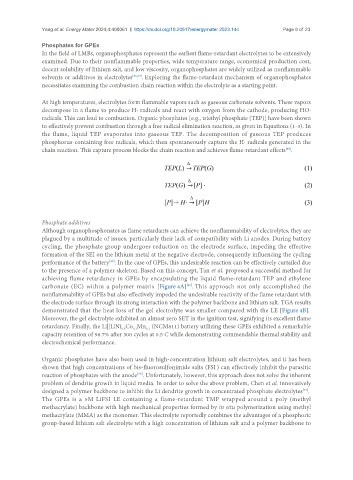
               to effectively prevent combustion through a free radical elimination reaction, as given in Equations (1-3). In
               the flame, liquid TEP evaporates into gaseous TEP. The decomposition of gaseous TEP produces
               phosphorus-containing free radicals, which then spontaneously capture the H· radicals generated in the
                                                                                                 [68]
               chain reaction. This capture process blocks the chain reaction and achieves flame-retardant effects .


               Phosphate additives
               Although organophosphonates as flame retardants can achieve the nonflammability of electrolytes, they are
               plagued by a multitude of issues, particularly their lack of compatibility with Li anodes. During battery
               cycling, the phosphate group undergoes reduction on the electrode surface, impeding the effective
               formation of the SEI on the lithium metal at the negative electrode, consequently influencing the cycling
               performance of the battery . In the case of GPEs, this undesirable reaction can be effectively curtailed due
                                      [45]
               to the presence of a polymer skeleton. Based on this concept, Tan et al. proposed a successful method for
               achieving flame retardancy in GPEs by encapsulating the liquid flame-retardant TEP and ethylene
                                                                [69]
               carbonate (EC) within a polymer matrix [Figure 4A] . This approach not only accomplished the
               nonflammability of GPEs but also effectively impeded the undesirable reactivity of the flame retardant with
               the electrode surface through its strong interaction with the polymer backbone and lithium salt. TGA results
               demonstrated that the heat loss of the gel electrolyte was smaller compared with the LE [Figure 4B].
               Moreover, the gel electrolyte exhibited an almost zero SET in the ignition test, signifying its excellent flame
               retardancy. Finally, the Li||LiNi Co Mn  (NCM811) battery utilizing these GPEs exhibited a remarkable
                                                  0.1
                                          0.8
                                              0.1
               capacity retention of 98.7% after 300 cycles at 0.5 C while demonstrating commendable thermal stability and
               electrochemical performance.
               Organic phosphates have also been used in high-concentration lithium salt electrolytes, and it has been
               shown that high concentrations of bis-fluorosulfonimide salts (FSI ) can effectively inhibit the parasitic
                                                                          -
               reaction of phosphates with the anode . Unfortunately, however, this approach does not solve the inherent
                                               [70]
               problem of dendrite growth in liquid media. In order to solve the above problem, Chen et al. innovatively
               designed a polymer backbone to inhibit the Li dendrite growth in concentrated phosphate electrolytes .
                                                                                                       [71]
               The GPEs is a 5M LiFSI LE containing a flame-retardant TMP wrapped around a poly (methyl
               methacrylate) backbone with high mechanical properties formed by in situ polymerization using methyl
               methacrylate (MMA) as the monomer. This electrolyte reportedly combines the advantages of a phosphoric
               group-based lithium salt electrolyte with a high concentration of lithium salt and a polymer backbone to

