


Page 193 - Read Online
P. 193
Page 4 of 23            Yang et al. Energy Mater 2024;4:400061  https://dx.doi.org/10.20517/energymater.2023.144


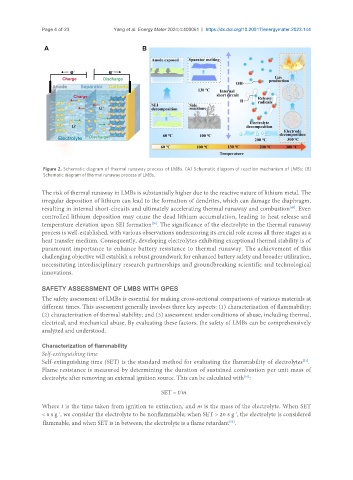
                Figure 2. Schematic diagram of thermal runaway process of LMBs. (A) Schematic diagram of reaction mechanism of LMBs; (B)
                Schematic diagram of thermal runaway process of LMBs.


               The risk of thermal runaway in LMBs is substantially higher due to the reactive nature of lithium metal. The
               irregular deposition of lithium can lead to the formation of dendrites, which can damage the diaphragm,
                                                                                                   [49]
               resulting in internal short-circuits and ultimately accelerating thermal runaway and combustion . Even
               controlled lithium deposition may cause the dead lithium accumulation, leading to heat release and
               temperature elevation upon SEI formation . The significance of the electrolyte in the thermal runaway
                                                    [50]
               process is well-established, with various observations underscoring its crucial role across all three stages as a
               heat transfer medium. Consequently, developing electrolytes exhibiting exceptional thermal stability is of
               paramount importance to enhance battery resistance to thermal runaway. The achievement of this
               challenging objective will establish a robust groundwork for enhanced battery safety and broader utilization,
               necessitating interdisciplinary research partnerships and groundbreaking scientific and technological
               innovations.


               SAFETY ASSESSMENT OF LMBS WITH GPES
               The safety assessment of LMBs is essential for making cross-sectional comparisons of various materials at
               different times. This assessment generally involves three key aspects: (1) characterization of flammability;
               (2) characterization of thermal stability; and (3) assessment under conditions of abuse, including thermal,
               electrical, and mechanical abuse. By evaluating these factors, the safety of LMBs can be comprehensively
               analyzed and understood.

               Characterization of flammability
               Self-extinguishing time
               Self-extinguishing time (SET) is the standard method for evaluating the flammability of electrolytes .
                                                                                                       [51]
               Flame resistance is measured by determining the duration of sustained combustion per unit mass of
               electrolyte after removing an external ignition source. This can be calculated with :
                                                                                   [52]
                                                       SET = t/m

               Where t is the time taken from ignition to extinction, and m is the mass of the electrolyte. When SET
                                                                                -1
               < 6 s g , we consider the electrolyte to be nonflammable; when SET > 20 s g , the electrolyte is considered
                    -1
               flammable, and when SET is in between, the electrolyte is a flame retardant .
                                                                              [53]

