


Page 13 - Read Online
P. 13
Alvarez-Tirado et al. Energy Mater 2023;3:300003  https://dx.doi.org/10.20517/energymater.2022.59  Page 9 of 14


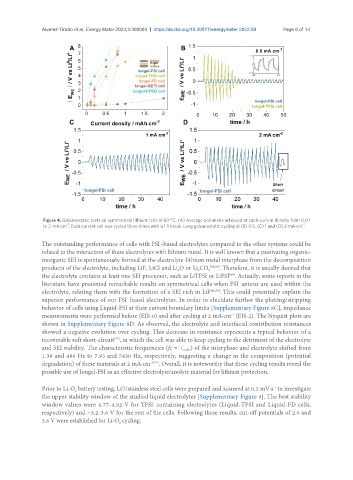
                Figure 4. Galvanostatic tests on symmetrical lithium cells at 60 °C. (A) Average potentials achieved at each current density from 0.01
                       -2
                                                                                                       -2
                to 2 mA·cm . Each current cell was cycled three times with a 1 h break. Long galvanostatic cycling at (B) 0.5, (C) 1 and (D) 2 mA·cm .
               The outstanding performance of cells with FSI -based electrolytes compared to the other systems could be
                                                       -
               related to the interaction of these electrolytes with lithium metal. It is well known that a passivating organic-
               inorganic SEI is spontaneously formed at the electrolyte-lithium metal interphase from the decomposition
               products of the electrolyte, including LiF, LiCl and Li O or Li CO 3 [48,49] . Therefore, it is usually desired that
                                                                    2
                                                             2
                                                                              [48]
               the electrolyte contains at least one SEI precursor, such as LiTFSI or LiFSI . Actually, some reports in the
               literature have presented remarkable results on symmetrical cells when FSI  anions are used within the
                                                                                 -
               electrolyte, relating them with the formation of a SEI rich in LiF [42,50] . This could potentially explain the
               superior performance of our FSI  based electrolytes. In order to elucidate further the platting/stripping
                                            -
               behavior of cells using Liquid-FSI at their current boundary limits [Supplementary Figure 8C], impedance
               measurements were performed before (EIS-0) and after cycling at 2 mA·cm  (EIS-2). The Nyquist plots are
                                                                               -2
               shown in Supplementary Figure 8D. As observed, the electrolyte and interfacial contribution resistances
               showed a negative evolution over cycling. This decrease in resistance represents a typical behavior of a
               recoverable soft short-circuit , in which the cell was able to keep cycling to the detriment of the electrolyte
                                       [47]
               and SEI stability. The characteristic frequencies (fc =  / 2πRC ) of the interphase and electrolyte shifted from
                                                             1
               1.38 and 486 Hz to 7.93 and 5430 Hz, respectively, suggesting a change in the composition (potential
               degradation) of these materials at 2 mA·cm -2[51] . Overall, it is noteworthy that these cycling results reveal the
               possible use of Iongel-FSI as an effective electrolyte/anolyte material for lithium protection.


               Prior to Li-O  battery testing, Li //stainless steel cells were prepared and scanned at 0.2 mV·s  to investigate
                                                                                             -1
                                          0
                          2
               the upper stability window of the studied liquid electrolytes [Supplementary Figure 9]. The best stability
               window values were 4.77-4.92 V for TFSI  containing electrolytes (Liquid-TFSI and Liquid-FD cells,
                                                     -
               respectively) and ~3.2-3.6 V for the rest of the cells. Following these results, cut-off potentials of 2.0 and
               3.6 V were established for Li-O  cycling.
                                         2

