


Page 11 - Read Online
P. 11
Alvarez-Tirado et al. Energy Mater 2023;3:300003  https://dx.doi.org/10.20517/energymater.2022.59  Page 7 of 14


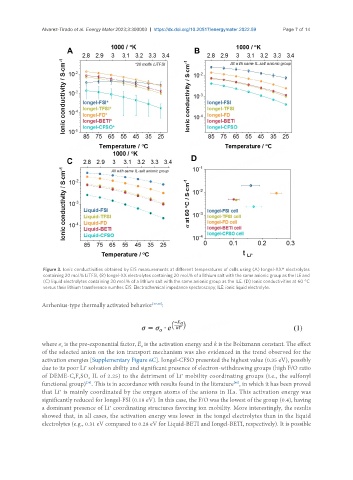
                Figure 3. Ionic conductivities obtained by EIS measurements at different temperatures of cells using (A) Iongel-XX* electrolytes
                containing 20 mol.% LiTFSI, (B) Iongel-XX electrolytes containing 20 mol.% of a lithium salt with the same anionic group as the ILE and
                (C) liquid electrolytes containing 20 mol.% of a lithium salt with the same anionic group as the ILE. (D) Ionic conductivities at 60 °C
                versus their lithium transference number. EIS: Electrochemical impedance spectroscopy; ILE: ionic liquid electrolyte.

               Arrhenius-type thermally activated behavior [37,38] :


               where σ  is the pre-exponential factor, E  is the activation energy and k is the Boltzmann constant. The effect
                      o
                                                 a
               of the selected anion on the ion transport mechanism was also evidenced in the trend observed for the
               activation energies [Supplementary Figure 6C]. Iongel-CFSO presented the highest value (0.35 eV), possibly
               due to its poor Li  solvation ability and significant presence of electron-withdrawing groups (high F/O ratio
                              +
               of DEME-C F SO  IL of 2.25) to the detriment of Li  mobility coordinating groups (i.e., the sulfonyl
                                                              +
                          3 9
                               3
               functional group) . This is in accordance with results found in the literature , in which it has been proved
                                                                                [40]
                              [39]
                     +
               that Li  is mainly coordinated by the oxygen atoms of the anions in ILs. This activation energy was
               significantly reduced for Iongel-FSI (0.18 eV). In this case, the F/O was the lowest of the group (0.4), having
               a dominant presence of Li  coordinating structures favoring ion mobility. More interestingly, the results
                                      +
               showed that, in all cases, the activation energy was lower in the iongel electrolytes than in the liquid
               electrolytes (e.g., 0.31 eV compared to 0.28 eV for Liquid-BETI and Iongel-BETI, respectively). It is possible

