


Page 15 - Read Online
P. 15
Alvarez-Tirado et al. Energy Mater 2023;3:300003  https://dx.doi.org/10.20517/energymater.2022.59  Page 11 of 14

                                                                                                -2
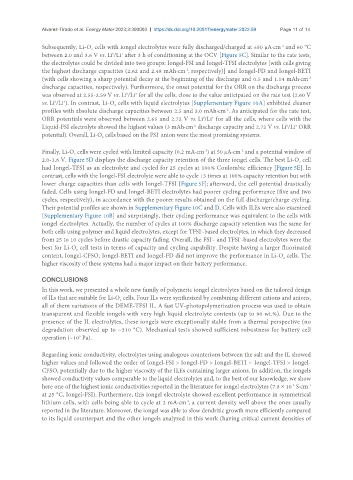
               Subsequently, Li-O  cells with iongel electrolytes were fully discharged/charged at ±50 μA·cm  and 60 °C
                                2
                                          +
                                       0
               between 2.0 and 3.6 V vs. Li /Li  after 3 h of conditioning at the OCV [Figure 5C]. Similar to the rate tests,
               the electrolytes could be divided into two groups: Iongel-FSI and Iongel-TFSI electrolytes [with cells giving
                                                                -2
               the highest discharge capacities (2.62 and 2.48 mAh·cm , respectively)] and Iongel-FD and Iongel-BETI
               (with cells showing a sharp potential decay at the beginning of the discharge and 0.5 and 1.14 mAh·cm
                                                                                                         -2
               discharge capacities, respectively). Furthermore, the onset potential for the ORR on the discharge process
               was observed at 2.55-2.59 V vs. Li /Li  for all the cells, close to the value anticipated on the rate test (2.60 V
                                            0
                                               +
                      +
                   0
               vs. Li /Li ). In contrast, Li-O  cells with liquid electrolytes [Supplementary Figure 10A] exhibited cleaner
                                        2
               profiles with absolute discharge capacities between 2.5 and 3.0 mAh·cm . As anticipated for the rate test,
                                                                             -2
               ORR potentials were observed between 2.65 and 2.72 V vs. Li /Li  for all the cells, where cells with the
                                                                     0
                                                                        +
                                                                                                  0
                                                                                                     +
                                                                  -2
               Liquid-FSI electrolyte showed the highest values (3 mAh·cm  discharge capacity and 2.72 V vs. Li /Li  ORR
               potential). Overall, Li-O  cells based on the FSI  anion were the most promising systems.
                                                      -
                                   2
                                                                                  -2
                                                                      -2
               Finally, Li-O  cells were cycled with limited capacity (0.2 mA·cm ) at 50 μA·cm  and a potential window of
                          2
               2.0-3.6 V. Figure 5D displays the discharge capacity retention of the three iongel cells. The best Li-O  cell
                                                                                                      2
               had Iongel-TFSI as an electrolyte and cycled for 25 cycles at 100% Coulombic efficiency [Figure 5E]. In
               contrast, cells with the Iongel-FSI electrolyte were able to cycle 13 times at 100% capacity retention but with
               lower charge capacities than cells with Iongel-TFSI [Figure 5F]; afterward, the cell potential drastically
               faded. Cells using Iongel-FD and Iongel-BETI electrolytes had poorer cycling performance (five and two
               cycles, respectively), in accordance with the poorer results obtained on the full discharge/charge cycling.
               Their potential profiles are shown in Supplementary Figure 10C and D. Cells with ILEs were also examined
               [Supplementary Figure 10B] and surprisingly, their cycling performance was equivalent to the cells with
               iongel electrolytes. Actually, the number of cycles at 100% discharge capacity retention was the same for
               both cells using polymer and liquid electrolytes, except for TFSI -based electrolytes, in which they decreased
                                                                     -
                                                                                  -
               from 25 to 10 cycles before drastic capacity fading. Overall, the FSI - and TFSI -based electrolytes were the
                                                                        -
               best for Li-O  cell tests in terms of capacity and cycling capability. Despite having a larger fluorinated
                           2
               content, Iongel-CFSO, Iongel-BETI and Iongel-FD did not improve the performance in Li-O  cells. The
                                                                                                2
               higher viscosity of these systems had a major impact on their battery performance.
               CONCLUSIONS
               In this work, we presented a whole new family of polymeric iongel electrolytes based on the tailored design
               of ILs that are suitable for Li-O  cells. Four ILs were synthesized by combining different cations and anions,
                                         2
               all of them variations of the DEME-TFSI IL. A fast UV-photopolymerization process was used to obtain
               transparent and flexible iongels with very high liquid electrolyte contents (up to 90 wt.%). Due to the
               presence of the IL electrolytes, these iongels were exceptionally stable from a thermal perspective (no
               degradation observed up to ~310 °C). Mechanical tests showed sufficient robustness for battery cell
               operation (~10  Pa).
                            5
               Regarding ionic conductivity, electrolytes using analogous counterions between the salt and the IL showed
               higher values and followed the order of Iongel-FSI > Iongel-FD > Iongel-BETI ~ Iongel-TFSI > Iongel-
               CFSO, potentially due to the higher viscosity of the ILEs containing larger anions. In addition, the iongels
               showed conductivity values comparable to the liquid electrolytes and, to the best of our knowledge, we show
                                                                                                   -3
               here one of the highest ionic conductivities reported in the literature for iongel electrolytes (7.8 × 10  S·cm
                                                                                                         -1
               at 25 °C, Iongel-FSI). Furthermore, this iongel electrolyte showed excellent performance in symmetrical
                                                                -2
               lithium cells, with cells being able to cycle at 2 mA·cm , a current density well above the ones usually
               reported in the literature. Moreover, the iongel was able to slow dendritic growth more efficiently compared
               to its liquid counterpart and the other iongels analyzed in this work (having critical current densities of

