


Page 106 - Read Online
P. 106
Yang et al. Energy Mater 2023;3:300029  https://dx.doi.org/10.20517/energymater.2023.10  Page 13 of 18


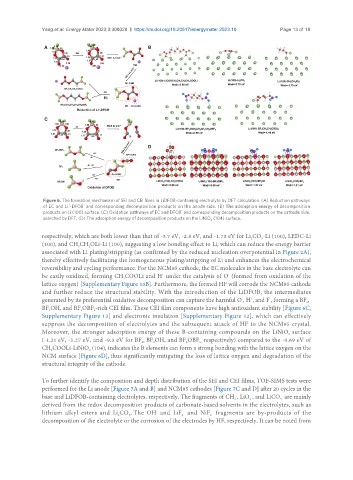
                Figure 6. The formation mechanism of SEI and CEI films in LiDFOB-containing electrolyte by DFT calculation. (A) Reduction pathways
                             -
                        +
                of EC and Li -DFOB  and corresponding decomposition products on the anode side. (B) The adsorption energy of decomposition
                                                              -
                products on Li (100) surface. (C) Oxidation pathways of EC and DFOB  and corresponding decomposition products on the cathode side,
                searched by DFT. (D) The adsorption energy of decomposition products on the LiNiO  (104) surface.
                                                                        2
               respectively, which are both lower than that of -3.7 eV, -2.8 eV, and -1.73 eV for Li CO -Li (100), LEDC-Li
                                                                                         3
                                                                                      2
               (100), and CH CH OLi-Li (100), suggesting a low bonding effect to Li, which can reduce the energy barrier
                               2
                           3
               associated with Li plating/stripping (as confirmed by the reduced nucleation overpotential in Figure 2A),
               thereby effectively facilitating the homogeneous plating/stripping of Li and enhances the electrochemical
               reversibility and cycling performance. For the NCM85 cathode, the EC molecules in the base electrolyte can
                                                        +
                                                                              -
               be easily oxidized, forming CH COOLi and H  under the catalysis of O  (formed from oxidation of the
                                           3
               lattice oxygen) [Supplementary Figure 10B]. Furthermore, the formed HF will corrode the NCM85 cathode
               and further reduce the structural stability. With the introduction of the LiDFOB, the intermediates
               generated by its preferential oxidative decomposition can capture the harmful O , H , and F , forming a BF ,
                                                                                      +
                                                                                            -
                                                                                   -
                                                                                                        3
               BF OH, and BF OBF -rich CEI film. These CEI film components have high antioxidant stability [Figure 6C,
                                 2
                            2
                 2
               Supplementary Figure 13] and electronic insulation [Supplementary Figure 12], which can effectively
               suppress the decomposition of electrolytes and the subsequent attack of HF to the NCM85 crystal.
               Moreover, the stronger adsorption energy of these B-containing compounds on the LiNiO  surface
                                                                                                  2
               (-1.21 eV, -1.27 eV, and -9.3 eV for BF , BF OH, and BF OBF  respectively) compared to the -0.69 eV of
                                                     2
                                                                2
                                                                    2,
                                                 3
               CH COOLi-LiNiO  (104), indicates the B elements can form a strong bonding with the lattice oxygen on the
                               2
                  3
               NCM surface [Figure 6D], thus significantly mitigating the loss of lattice oxygen and degradation of the
               structural integrity of the cathode.
               To further identify the composition and depth distribution of the SEI and CEI films, TOF-SIMS tests were
               performed for the Li anode [Figure 7A and B] and NCM85 cathodes [Figure 7C and D] after 20 cycles in the
               base and LiDFOB-containing electrolytes, respectively. The fragments of CH , LiO , and LiCO  are mainly
                                                                                                -
                                                                                 -
                                                                                      -
                                                                                     2
                                                                                               3
                                                                                2
               derived from the redox decomposition products of carbonate-based solvents in the electrolytes, such as
               lithium  alkyl  esters  and  Li CO . The  OH   and  LiF   and  NiF   fragments  are  by-products  of  the
                                                      -
                                                               -
                                                                        -
                                                              2
                                                                        2
                                         2
                                            3
               decomposition of the electrolyte or the corrosion of the electrodes by HF, respectively. It can be noted from

