


Page 86 - 2417
P. 86
Salmerón et al. Carbon Footprints 2026, 5, 17                                    Page 17 of 26


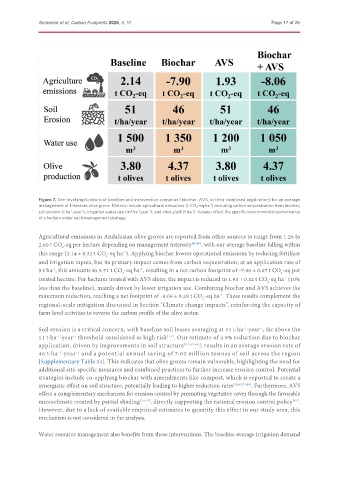
               Figure 7. Site-level implications of baseline and intervention scenarios (biochar, AVS, or their combined application) for an average
               management of 1-hectare olive grove. Metrics include agricultural emissions (t CO 2 -eq·ha ) including carbon sequestration from biochar,
                                                                           -1
               soil erosion (t·ha ·year ), irrigation water use (m ·ha ·year ), and olive yield (t·ha ). Values reflect the specific environmental performance
                                                     -1
                                                                    -1
                                                 -1
                          -1
                              -1
                                               3
               of a hectare under each management strategy.
               Agricultural emissions in Andalusian olive groves are reported from other sources to range from 1.26 to
               2.60 t CO -eq per hectare depending on management intensity [45,46] , with our average baseline falling within
                       2
               this range (2.14 ± 0.32 t CO -eq ha ). Applying biochar lowers operational emissions by reducing fertilizer
                                            -1
                                      2
               and irrigation inputs, but its primary impact comes from carbon sequestration; at an application rate of
               5 t ha , this amounts to 9.71 t CO -eq ha , resulting in a net carbon footprint of -7.90 ± 0.27 t CO -eq per
                   -1
                                                  -1
                                                                                                    2
                                            2
               treated hectare. For hectares treated with AVS alone, the impact is reduced to 1.93 ± 0.32 t CO -eq ha  (10%
                                                                                                     -1
                                                                                               2
               less than the baseline), mainly driven by lower irrigation use. Combining biochar and AVS achieves the
               maximum reduction, reaching a net footprint of -8.06 ± 0.28 t CO -eq ha . These results complement the
                                                                              -1
                                                                        2
               regional-scale mitigation discussed in Section "Climate change impacts", reinforcing the capacity of
               farm-level activities to reverse the carbon profile of the olive sector.
               Soil erosion is a critical concern, with baseline soil losses averaging at 51 t·ha ·year , far above the
                                                                                      -1
                                                                                            -1
               11 t·ha ·year  threshold considered as high risk . Our estimate of a 9% reduction due to biochar
                           -1
                     -1
                                                            [14]
               application, driven by improvements in soil structure [23,62,66] , results in an average erosion rate of
               46 t·ha ·year  and a potential annual saving of 7.02 million tonnes of soil across the region
                     -1
                            -1
               [Supplementary Table 24]. This indicates that olive groves remain vulnerable, highlighting the need for
               additional site-specific measures and combined practices to further increase erosion control. Potential
               strategies include co-applying biochar with amendments like compost, which is reported to create a
               synergistic effect on soil structure, potentially leading to higher reduction rates [23,65,71,80] . Furthermore, AVS
               offers a complementary mechanism for erosion control by promoting vegetative cover through the favorable
               microclimate created by partial shading [34,71] , directly supporting the national erosion control policy .
                                                                                                        [81]
               However, due to a lack of available empirical estimates to quantify this effect in our study area, this
               mechanism is not considered in the analysis.
               Water resource management also benefits from these interventions. The baseline average irrigation demand

