Page 52 - 2417
P. 52

François et al. Carbon Footprints 2026, 5, 22                                     Page 5 of 22


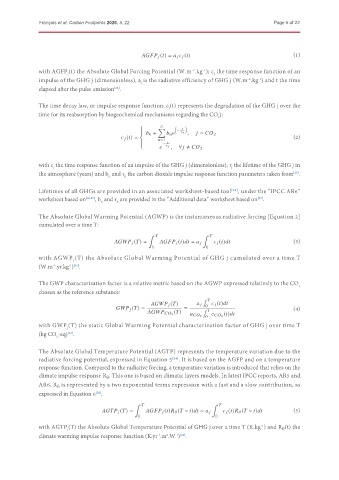
                                                      % 9 (C) = 0 9 2 9 (C)                             (1)
               with AGFP (t) the Absolute Global Forcing Potential (W.m .kg ); c the time response function of an
                                                                        -1
                                                                    -2
                         j
                                                                            j
               impulse of the GHG j (dimensionless), a is the radiative efficiency of GHG j (W.m .kg ) and t the time
                                                                                            -1
                                                                                        -2
                                                  j
               elapsed after the pulse emission .
                                         [24]
               The time decay law, or impulse response function, c(t) represents the degradation of the GHG j over the
                                                            j
               time (or its reabsorption by biogeochemical mechanisms regarding the CO ):
                                                                              2

                                                        3 Õ     C
                                                              −
                                                    1 0 +  1 = e  g =  ,  9 =  $ 2
                                                  
                                            2 9 (C) =                                                   (2)
                                                        ==1
                                                           C
                                                         −
                                                        4  g 9  ,
                                                               ∀9 ≠  $ 2
               with c the time response function of an impulse of the GHG j (dimensionless), τ the lifetime of the GHG j in
                                                                                  j
                    j
               the atmosphere (years) and b  and τ  the carbon dioxide impulse response function parameters taken from .
                                                                                                        [25]
                                       n
                                             n
               Lifetimes of all GHGs are provided in an associated worksheet-based tool , under the “IPCC AR6”
                                                                                  [22]
               worksheet based on [26,27] , b  and τ  are provided in the “Additional data” worksheet based on .
                                                                                           [25]
                                          n
                                    n
               The Absolute Global Warming Potential (AGWP) is the instantaneous radiative forcing [Equation 2]
               cumulated over a time T:
                                                        )                  )
                                                     ∫                  ∫
                                           ,% 9 ()) =       % 9 (C)3C = 0 9  2 9 (C)3C                  (3)
                                                      0                  0
               with AGWP (T) the Absolute Global Warming Potential of GHG j cumulated over a time T
                           j
               (W.m .yr.kg ) .
                         -1 [24]
                    -2
               The GWP characterization factor is a relative metric based on the AGWP expressed relatively to the CO 2
               chosen as the reference substance:
                                                                        ∫  )
                                                        ,% 9 ())      0 9  2 9 (C)3C
                                           ,% 9 ()) =             =     ∫ 0                             (4)
                                                              ())         )
                                                       ,%  $ 2                  (C)3C
                                                                           2  $ 2
                                                                    0  $ 2 0
               with GWP (T) the static Global Warming Potential characterization factor of GHG j over time T
                         j
               (kg CO -eq) .
                         [24]
                     2
               The Absolute Global Temperature Potential (AGTP) represents the temperature variation due to the
               radiative forcing potential, expressed in Equation 5 . It is based on the AGFP and on a temperature
                                                              [24]
               response function. Compared to the radiative forcing, a temperature variation is introduced that relies on the
               climate impulse response R . This one is based on climatic layers models. In latest IPCC reports, AR5 and
                                      θ
               AR6, R  is represented by a two exponential terms expression with a fast and a slow contribution, as
                     θ
               expressed in Equation 6 .
                                   [28]
                                                ∫  )                       ∫  )
                                       )% 9 ()) =      % 9 (C)' \ () − C)3C = 0 9  2 9 (C)' \ () − C)3C  (5)
                                                 0                           0
               with AGTP (T) the Absolute Global Temperature Potential of GHG j over a time T (K.kg ) and R (t) the
                                                                                             -1
                                                                                                    θ
                         j
               climate warming impulse response function (K.yr .m .W ) .
                                                        -1
                                                           2
                                                               -1 [24]
   47   48   49   50   51   52   53   54   55   56   57