


Page 48 - 2417
P. 48
Original Article  |  Open Access

                                          Carbon Footprints


                                       François et al. Carbon Footprints 2026, 5, 22      DOI:10.20517/cf.2025.117


               Revised dynamic climate change impact assessment
               for life cycle assessment through delay factors
               expressions


               Cyrille François 1,2  , Fatima-Zahrae El-Amrani , Guillaume Batot , Anne Ventura 2
                                                                     3
                                                      3
               Keywords:
               Dynamic life cycle impact
               assessment, integration
               time, environmental
               regulation, carbon storage,
               global warming potential,
               global temperature potential

               Citation: François, C.;
               El-Amrani, F. Z.; Batot, G.;
               Ventura, A. Revised dynamic
               climate change impact
               assessment for life cycle
               assessment through delay
               factors expressions. Carbon
               Footprints 2026, 5, 22.
               https://dx.doi.org/10.20517
               /cf.2025.117
                                   Abstract
               Received: 13 Dec 2025
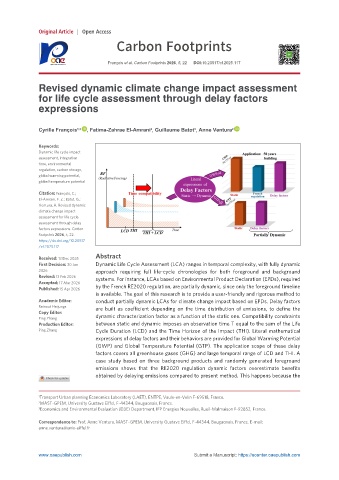
               First Decision: 30 Jan  Dynamic Life Cycle Assessment (LCA) ranges in temporal complexity, with fully dynamic
               2026                approach   requiring   full   life-cycle   chronologies   for   both   foreground   and   background
               Revised: 13 Feb 2026  systems. For instance, LCAs based on Environmental Product Declaration (EPDs), required
               Accepted: 17 Mar 2026
               Published: 15 Apr 2026  by the French RE2020 regulation, are partially dynamic, since only the foreground timeline
                                   is available. The goal of this research is to provide a user-friendly and rigorous method to
               Academic Editor:    conduct partially dynamic LCAs for climate change impact based on EPDs. Delay factors
               Reinout Heijungs    are   built   as   coefficient   depending   on   the   time   distribution   of   emissions,   to   define   the
               Copy Editor:
               Ping Zhang          dynamic characterization factor as a function of the static one. Compatibility constraints
               Production Editor:  between static and dynamic imposes an observation time T equal to the sum of the Life
               Ping Zhang          Cycle  Duration  (LCD)  and  the  Time  Horizon  of  the  Impact  (THI).  Literal  mathematical
                                   expressions of delay factors and their behaviors are provided for Global Warming Potential
                                   (GWP)  and  Global  Temperature  Potential  (GTP).  The  application  scope  of  these  delay
                                   factors covers all greenhouse gases (GHG) and large temporal range of LCD and THI. A
                                   case   study   based   on   three   background   products   and   randomly   generated   foreground
                                   emissions   shows   that   the   RE2020   regulation   dynamic   factors   overestimate   benefits
                                   obtained by delaying emissions compared to present method. This happens because the


               1 Transport Urban planning Economics Laboratory (LAET), ENTPE, Vaulx-en-Velin F-69518, France.
               2 MAST-GPEM, University Gustave Eiffel, F-44344, Bouguenais, France.
               3 Economics and Environmental Evaluation (D3E) Department, IFP Energies Nouvelles, Rueil-Malmaison F-92852, France.

               Correspondence to: Prof. Anne Ventura, MAST-GPEM, University Gustave Eiffel, F-44344, Bouguenais, France. E-mail:
               anne.ventura@univ-eiffel.fr


               www.oaepublish.com                                    Submit a Manuscript: https://ucenter.oaepublish.com

