


Page 50 - 2417
P. 50
François et al. Carbon Footprints 2026, 5, 22                                     Page 3 of 22


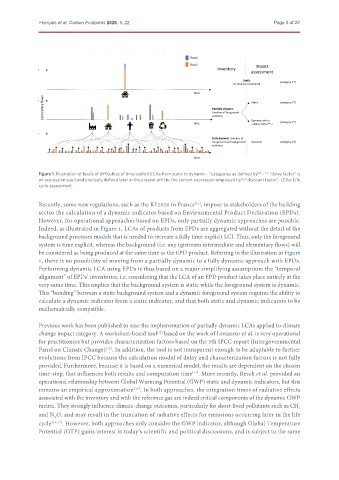
               Figure 1. Illustration of levels of difficulties of time explicit LCAs from static to dynamic - *categories as defined by  - ** “delay factor” is
                                                                                           [5]
               an expression used and precisely defined later in the present article, the current expression employed by  “discount factor”. LCAs: Life
                                                                                      [5]
               cycle assessment.
               Recently, some new regulations, such as the RE2020 in France , impose to stakeholders of the building
                                                                     [11]
               sector the calculation of a dynamic indicator based on Environmental Product Declaration (EPDs).
               However, for operational approaches based on EPDs, only partially dynamic approaches are possible.
               Indeed, as illustrated in Figure 1, LCAs of products from EPDs are aggregated without the detail of the
               background processes models that is needed to recreate a fully time-explicit LCI. Thus, only the foreground
               system is time explicit, whereas the background (i.e. any upstream intermediate and elementary flows) will
               be considered as being produced at the same time as the EPD product. Referring to the illustration in Figure
               1, there is no possibility of moving from a partially dynamic to a fully dynamic approach with EPDs.
               Performing dynamic LCA using EPDs is thus based on a major simplifying assumption: the “temporal
               alignment” of EPDs’ inventories, i.e. considering that the LCA of an EPD product takes place entirely at the
               very same time. This implies that the background system is static while the foreground system is dynamic.
               This “bonding” between a static background system and a dynamic foreground system requires the ability to
               calculate a dynamic indicator from a static indicator, and that both static and dynamic indicators to be
               mathematically compatible.

               Previous work has been published to ease the implementation of partially dynamic LCAs applied to climate
               change impact category. A worksheet-based tool  based on the work of Levasseur et al. is very operational
                                                        [12]
               for practitioners but provides characterization factors based on the 5th IPCC report (Intergovernmental
               Panel on Climate Change) . In addition, the tool is not transparent enough to be adaptable to further
                                      [13]
               evolutions from IPCC because the calculation model of delay and characterization factors is not fully
               provided. Furthermore, because it is based on a numerical model, the results are dependent on the chosen
               time-step, that influences both results and computation time . More recently, Resch et al. provided an
                                                                     [14]
               operational relationship between Global Warming Potential (GWP) static and dynamic indicators, but this
               remains an empirical approximation . In both approaches, the integration times of radiative effects
                                                [15]
               associated with the inventory and with the reference gas are indeed critical components of the dynamic GWP
               metric. They strongly influence climate-change outcomes, particularly for short-lived pollutants such as CH 4
               and N O, and may result in the truncation of radiative effects for emissions occurring later in the life
                    2
               cycle [16,17] . However, both approaches only consider the GWP indicator, although Global Temperature
               Potential (GTP) gains interest in today’s scientific and political discussions, and is subject to the same

