


Page 30 - Read online
P. 30
Artyukhov et al. Carbon Footprints 2026, 5, 8                                     Page 7 of 21


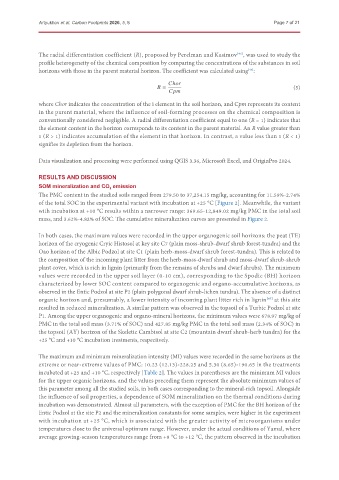
               The radial differentiation coefficient (R), proposed by Perelman and Kasimov , was used to study the
                                                                                    [46]
               profile heterogeneity of the chemical composition by comparing the concentrations of the substances in soil
               horizons with those in the parent material horizon. The coefficient was calculated using :
                                                                                        [45]

                                                              ℎ
                                                           =                                            (5)

               where Chor indicates the concentration of the i element in the soil horizon, and Cpm represents its content
               in the parent material, where the influence of soil-forming processes on the chemical composition is
               conventionally considered negligible. A radial differentiation coefficient equal to one (R = 1) indicates that
               the element content in the horizon corresponds to its content in the parent material. An R value greater than
               1 (R > 1) indicates accumulation of the element in that horizon. In contrast, a value less than 1 (R < 1)
               signifies its depletion from the horizon.


               Data visualization and processing were performed using QGIS 3.36, Microsoft Excel, and OriginPro 2024.


               RESULTS AND DISCUSSION
               SOM mineralization and CO 2  emission
               The PMC content in the studied soils ranged from 279.50 to 37,254.15 mg/kg, accounting for 11.59%-2.74%
               of the total SOC in the experimental variant with incubation at +25 °C [Figure 2]. Meanwhile, the variant
               with incubation at +10 °C results within a narrower range: 369.65-12,849.02 mg/kg PMC in the total soil
               mass, and 3.62%-4.82% of SOC. The cumulative mineralization curves are presented in Figure 2.

               In both cases, the maximum values were recorded in the upper organogenic soil horizons: the peat (TE)
               horizon of the cryogenic Cryic Histosol at key site C7 (plain moss-shrub-dwarf shrub forest-tundra) and the
               Oao horizon of the Albic Podzol at site C1 (plain herb-moss-dwarf shrub forest-tundra). This is related to
               the composition of the incoming plant litter from the herb-moss-dwarf shrub and moss-dwarf shrub-shrub
               plant cover, which is rich in lignin (primarily from the remains of shrubs and dwarf shrubs). The minimum
               values were recorded in the upper soil layer (0-10 cm), corresponding to the Spodic (BH) horizon
               characterized by lower SOC content compared to organogenic and organo-accumulative horizons, as
               observed in the Entic Podzol at site P2 (plain polygonal dwarf shrub-lichen tundra). The absence of a distinct
               organic horizon and, presumably, a lower intensity of incoming plant litter rich in lignin  at this site
                                                                                               [47]
               resulted in reduced mineralization. A similar pattern was observed in the topsoil of a Turbic Podzol at site
               P1. Among the upper organogenic and organo-mineral horizons, the minimum values were 678.97 mg/kg of
               PMC in the total soil mass (3.71% of SOC) and 427.85 mg/kg PMC in the total soil mass (2.34% of SOC) in
               the topsoil (AY) horizon of the Skeletic Cambisol at site C2 (mountain dwarf shrub-herb tundra) for the
               +25 °C and +10 °C incubation treatments, respectively.


               The maximum and minimum mineralization intensity (MI) values were recorded in the same horizons as the
               extreme or near-extreme values of PMC: 10.23 (12.13)-228.25 and 5.30 (8.65)-190.65 in the treatments
               incubated at +25 and +10 °C, respectively [Table 2]. The values in parentheses are the minimum MI values
               for the upper organic horizons, and the values preceding them represent the absolute minimum values of
               this parameter among all the studied soils, in both cases corresponding to the mineral-rich topsoil. Alongside
               the influence of soil properties, a dependence of SOM mineralization on the thermal conditions during
               incubation was demonstrated. Almost all parameters, with the exception of PMC for the BH horizon of the
               Entic Podzol at the site P2 and the mineralization constants for some samples, were higher in the experiment
               with incubation at +25 °C, which is associated with the greater activity of microorganisms under
               temperatures close to the universal optimum range. However, under the actual conditions of Yamal, where
               average growing-season temperatures range from +8 °C to +12 °C, the pattern observed in the incubation

