


Page 80 - Read Online
P. 80
Hu et al. Carbon Footprints 2024;3:16  https://dx.doi.org/10.20517/cf.2024.28   Page 13 of 16

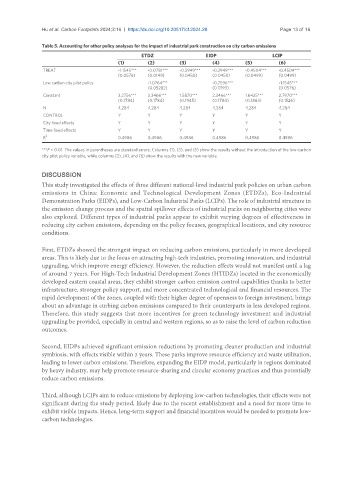
               Table 5. Accounting for other policy analyses for the impact of industrial park construction on city carbon emissions
                                                 ETDZ                 EIDP                   LCIP
                                         (1)       (2)        (3)        (4)        (5)        (6)
                TREAT                    -1.1545***   -0.0781***   -0.3949***   -0.3949***   -0.4504***   -0.4504***
                                         (0.0576)  (0.0149)   (0.0450)   (0.0450)   (0.0499)   (0.0499)
                Low carbon city pilot policy       -1.0764***            -0.7596***            -1.1545***
                                                   (0.05282)             (0.0193)              (0.0576)
                Constant                 2.2756***   2.3466***   1.5870***   2.3466***   1.6425***   2.7970***
                                         (0.1784)  (0.1784)   (0.1945)   (0.1784)   (0.1863)   (0.1526)
                N                        4,284     4,284      4,284      4,284      4,284      4,284
                CONTROL                  Y         Y          Y          Y          Y          Y
                City fixed effects       Y         Y          Y          Y          Y          Y
                Time fixed effects       Y         Y          Y          Y          Y          Y
                2
                R                        0.4986    0.4986     0.4986     0.4986     0.4986     0.4986
               ***P < 0.01. The values in parentheses are standard errors. Columns (1), (3), and (5) show the results without the introduction of the low-carbon
               city pilot policy variable, while columns (2), (4), and (6) show the results with the new variable.


               DISCUSSION
               This study investigated the effects of three different national-level industrial park policies on urban carbon
               emissions in China: Economic and Technological Development Zones (ETDZs), Eco-Industrial
               Demonstration Parks (EIDPs), and Low-Carbon Industrial Parks (LCIPs). The role of industrial structure in
               the emission change process and the spatial spillover effects of industrial parks on neighboring cities were
               also explored. Different types of industrial parks appear to exhibit varying degrees of effectiveness in
               reducing city carbon emissions, depending on the policy focuses, geographical locations, and city resource
               conditions.


               First, ETDZs showed the strongest impact on reducing carbon emissions, particularly in more developed
               areas. This is likely due to the focus on attracting high-tech industries, promoting innovation, and industrial
               upgrading, which improve energy efficiency. However, the reduction effects would not manifest until a lag
               of around 7 years. For High-Tech Industrial Development Zones (HTIDZs) located in the economically
               developed eastern coastal areas, they exhibit stronger carbon emission control capabilities thanks to better
               infrastructure, stronger policy support, and more concentrated technological and financial resources. The
               rapid development of the zones, coupled with their higher degree of openness to foreign investment, brings
               about an advantage in curbing carbon emissions compared to their counterparts in less developed regions.
               Therefore, this study suggests that more incentives for green technology investment and industrial
               upgrading be provided, especially in central and western regions, so as to raise the level of carbon reduction
               outcomes.


               Second, EIDPs achieved significant emission reductions by promoting cleaner production and industrial
               symbiosis, with effects visible within 3 years. These parks improve resource efficiency and waste utilization,
               leading to lower carbon emissions. Therefore, expanding the EIDP model, particularly in regions dominated
               by heavy industry, may help promote resource-sharing and circular economy practices and thus potentially
               reduce carbon emissions.

               Third, although LCIPs aim to reduce emissions by deploying low-carbon technologies, their effects were not
               significant during the study period, likely due to the recent establishment and a need for more time to
               exhibit visible impacts. Hence, long-term support and financial incentives would be needed to promote low-
               carbon technologies.

